
From one large superspeedway to another, the stars of the NASCAR Cup Series enters the hallowed chutes and straights of Indianapolis Motor Speedway to tackle the oval for the first time since 2020.
Trials and tribulations awaited several drivers in Long Pond, Pennsylvania last week for the The Great American Getaway 400 at Pocono Raceway.
Ty Gibbs jumped out to an early lead from the pole until Noah Gragson’s Overstock Ford backed into the turn 1 wall on lap 14, scattering pit strategy in the process.
The rest of stage 1 played out and brought out the second caution of the day with Martin Truex Jr. passing Gibbs on the lap 18 restart, securing his third stage win of 2024.
Joey Logano assumed the lead for the following restart where Brad Keselowski took the point from his former teammate for the next 20 laps when Ross Chastain’s Busch Peach Chevy slapped the outside wall in turn 3, bringing out the race’s third caution on lap 53.
This provided a golden opportunity for the teams that stopped during the first caution to mostly maintain their track position. The Chastain yellow brought Gibbs’ Monster Energy Camry back to the front alongside Josh Berry’s Overstock Ford for the restart.
Berry took command of the race while the cars on fresh tires sliced through the field. Pocono wins leader Denny Hamlin marched to the top spot, passing Berry on lap 67 and held the lead for the rest of stage 2 to claim his fifth stage win of the year.
Several teams elected to stop prior to the pit lane closing, including Chris Buescher and Ryan Blaney. Both drivers were able to stay on the lead lap and cycle ahead of the drivers pitting during the stage caution.
Stage 3 went green with 60 laps to go with Buescher scooting away, setting up a strategy showdown between the teams pitting 40 laps from the end and teams pitting closer to 20 laps from the end.
That was abruptly tossed aside when Todd Gilliland’s brake rotor left his race car on lap 115, bringing the entire field down pit road for what would be their final stops.
Several contenders found themselves on the penalty report: Kyle Larson, Chase Elliott, Daniel Suárez, and Ty Gibbs were all caught speeding in section 7 on pit road. Yes, the exact same section.
Ryan Blaney assumed the lead for the lap 121 restart with no teams on the grid projected to make it to the end on fuel. so Corey Lajoie decided to give 80% of the field some breathing room.
The embattled driver took a big run on the restart and attempted to dive inside of Kyle Busch. Busch’s zOne Chevy blocked Lajoie’s advances to which Lajoie took offense.
Lajoie drove through Busch’s left-rear quarter panel, sending the two-time champion sliding backwards (facing driver’s side) into oncoming traffic, collecting the likes of Harrison Burton, Ryan Preece, Austin Cindric, Ricky Stenhouse Jr., and AJ Allmendinger.
Lajoie came out of this smelling like a rose, completely unscathed and without penalty for causing this objectively dangerous crash that he claimed Busch caused by “blocking” him twice. To the shock of many, Lajoie faced no further discipline during the week for this incident.
An extensive five-lap cleanup ensued before the race resumed on lap 127. Chase Elliott forced it four-wide beneath Zane Smith, Michael McDowell, and John Hunter Nemechek, resulting in a three-car wreck that ended the days of Smith and Nemechek.
Another lengthy cleanup was followed by another short restart where the engine expired on Ty Gibbs’ Monster machine, putting him behind the wall for just the second time this year.
Thankfully, that caution would be the last of the day, and after another perfectly-executed restart, the defending series champ motored away to give Ford their first win on a non-drafting superspeedway since Chris Buescher’s win at Michigan last year.
The victory was Blaney’s second win in a month and the 12th of his Cup career, squaring himself up to be a fitting title contender this summer with a string of strong runs.
NASCAR History at IMS
Indianapolis Motor Speedway exclusively held the NTT IndyCar Series for much of its history, yet the Speedway heard proposals from various factions about adding a second racing event.
In 1968, USAC requested a second race be held at Indy for their stock car division that never met the green light. The group lobbed another failed request in the late-70s after the USAC/CART split to host a pair of 250-lap events late in the summer where their stock car division ran one race and the other run with IndyCars.
While USAC kept pressing, the biggest push came from NASCAR in 1980. “Big” Bill France threatened to relocate Daytona’s summer race to Indianapolis, though the tax dispute with the City of Daytona Beach and Volusia County was settled before any concrete plans materialized.
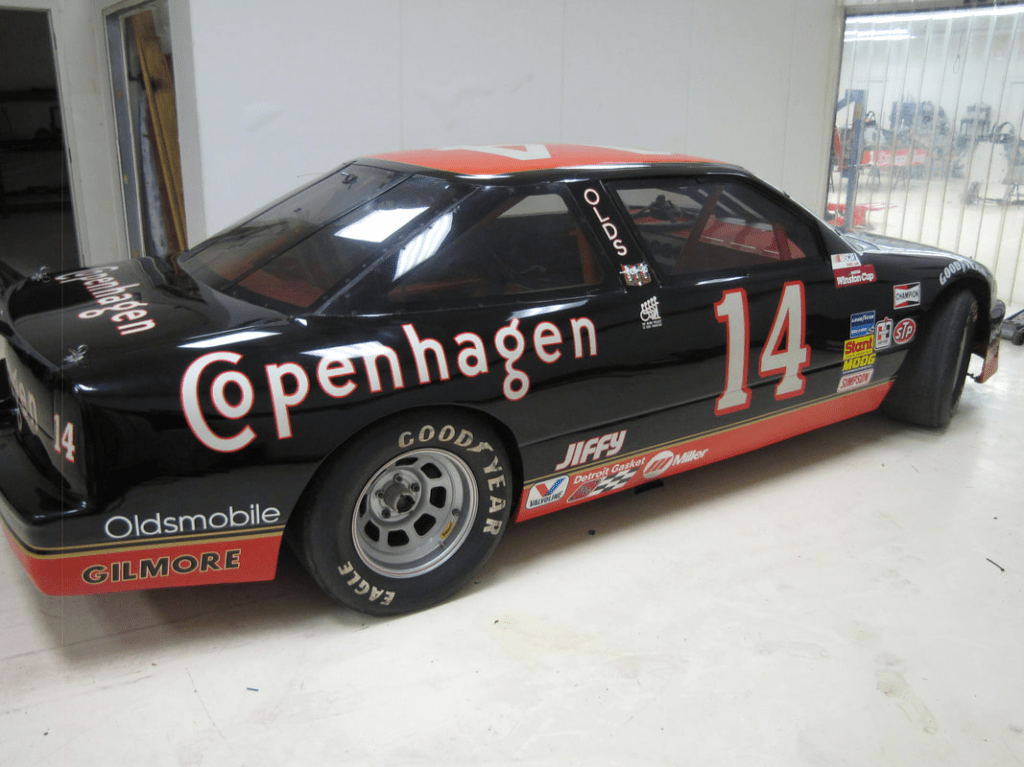
For years, stock cars logged a few test sessions or endurance runs at the famed circuit. It wasn’t until September 1991 when AJ Foyt — who stored his stock cars in the IMS garages at times — got the okay from new track president Tony George to put his #14 stock car out on the track for a few laps.
Both Foyt and George got behind the wheel of the car for the Craftsman Tools commercial they were filming, inspiring the track president to go to his board of directors about adding a second date to Indy’s schedule.
The proposal was approved, and after flirting with adding an IROC date, George contacted a shortlist of NASCAR drivers and teams to make their way up to Indiana’s capital for a Goodyear tire test.
Among the invitees were NASCAR Hall of Famers Dale Earnhardt, Davey Allison, Rusty Wallace, Mark Martin, and Darrell Waltrip. Foyt even returned to the circuit and took Earnhardt’s #3 Chevy out for testing.
This “unofficial” compatibility test sent the 2.5-mile oval into a massive renovation to get ready for big-time stock car racing that saw the track reinforce its retaining walls, garage area, pit stalls, and catchfencing.
Tony George and Bill France Jr. called a press conference to announce the first NASCAR event held at Indianapolis, the Brickyard 400, and setting the date for August 6, 1994.
Inaugural races tend to draw lots of interest from fans and teams. The Brickyard 400 was different.
A record 86 cars attempted to qualify for the Brickyard 400 with names like Dick Trickle, Ron Hornaday Jr., PJ Jones, Charlie Glotzbach, and Butch Gilliland missing out on the inaugural running.
Snarling engines from 43 entries filled up Gasoline Alley with hordes of screaming fans packing the stands for this monumental day in stock car racing where Rick Mast became the first stock car driver to sit on pole.
Prestige and hype had been building in NASCAR circles as every driver wanted to be the first person to at Indy, so much so that brothers Geoff and Brett Bodine collided for the lead on lap 101.
Brett stayed in the mix while Geoff’s self-owned car was destroyed. Much of the day was spent looking at the back bumper of the DuPont Chevy Lumina piloted by Indiana boy Jeff Gordon.
The Hendrick Motorsports legend made a name for himself earlier in the year when he won his first Cup race in the Coca-Cola 600. When he made the pass on the ailing car of Ernie Irvan with seven laps to go, Gordon never looked back, becoming the first victor in a NASCAR race at IMS.
Since that day, Gordon became the winningest driver in the track’s history, victorious five times in the Brickyard 400. Icons of stock car racing found victory lane in the Hoosier State after that first race in 1994 with Dale Jarrett, Tony Stewart, Kevin Harvick, Jimmie Johnson, and Kyle Busch taking multiple trips.
After Harvick’s third win at the event in 2020, new track owner Roger Penske decided to switch gears and put the NASCAR weekend on the track’s FIA Grade 1 road course where the event lasted for three years.
Now, the current crop of Cup Series talent returns to the oval for the 30th anniversary of that inaugural visit, and everyone in the garage is eager to place their names in the annals of Indianapolis history and a smooch on the Yard of Bricks lining the finish line.
Let’s get to know the track, shall we?
The Track

Ripping down the 3,300-foot frontstretch, drivers cross the Yard of Bricks two-thirds of the way to turn 1 where they lift on the approach to turn 1.
The low-grade, sweeping 1/4-mile turn 1 welcomes the roaring pack with its 9.2° slopes into their first challenge: making it to the second turn.
Winding to the left near the grass helps roll the car through to the 1/8-mile short chute, a slight chance to catch your breath until diving into the equally sharp 9.2° turn 2 that funnels out to the back straightaway.
Cars leak out toward the wall on the exit of turn 2, and on restarts, driver use the entire 60 feet of width on the backstretch to defend their positions, snaking along the 5/8-mile straight to break the draft for trailing cars.
These hefty metal machines decelerate dramatically into turn 3 as the second half of the circuit resembles the first, meaning that this circuit only provides one real racing line through the corners.
Figuring out how to make passes on the outside is how Jeff Gordon scored his first win here and how Josef Newgarden earned his Indy 500 victory back in May.
Another short chute greets drivers lucky enough to survive the third turn only to whip their heaving carbon-fiber beasts into the dreaded turn 4 that put an end to Geoff Bodine’s day back in 1994.
If a driver engages in a duel with another driver as they enter the homestretch, they do whatever it takes to defend, even getting a little reckless with the inside pit wall before flying across the the line to finish the lap.
Weather & Fast Facts
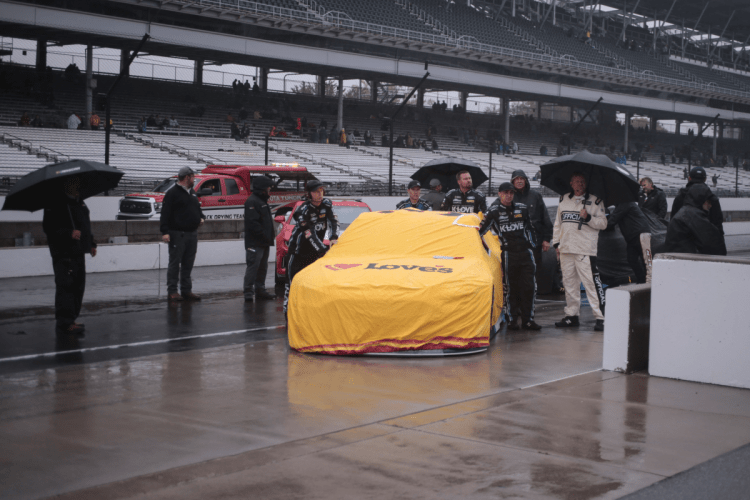
The forecast from AccuWeather projects a high of 84 degrees on race day with mostly cloudy skies and less than a 20% chance of precipitation in the area.
Even Pocono suffered from early rain showers on Sunday morning before last week’s Cup race (as well as stopping a Truck Series race on Friday evening), so hopefully, Mother Nature shines on the Racing Capital of the World on its second-largest weekend of the year.
As for the last 10 years at Indianapolis, the last three NASCAR visits have been on the road course. As a result, I’ll only be analyzing the last seven races on the oval layout.
The average oval race at Indianapolis features: 9 cautions for 39 caution laps; 12 lead changes; 2,177 green-flag passes (18 passes per green-flag lap); and, four of the last seven Brickyard 400s ended in Overtime with the lap of final caution coming out on lap 154.
NBC will broadcast Sunday’s race, starting at 2:30pm Eastern time. The 28th running of the event will have three stages that end on laps 50-100-160.
The average runtime of this event falls at 3 hours and 12 minutes, so if you’re thinking of making plans for after the race, you would be better off waiting until after 6pm ET to set anything up for the evening.
The Odds
On Wednesday this week, the fine folks at DraftKings released their betting favorites for this weekend’s race, and who do you think topped the list?
If your guess was Denny Hamlin (+400), you’d be correct! The 20-year Cup veteran makes his 16th start in Indiana’s state capital this weekend, hungrier than nearly every driver in the field to earn a win here.
Hamlin took center stage in 2020 when he grabbed the lead from Kevin Harvick in the closing laps, but a poorly-timed blown tire shot the FedEx Camry into the turn 1 wall with six to go. Having run the tire test here in June, Hamlin should have the data and savvy to get the last Crown Jewel into his collection this weekend.
The 2024 Indy 500 rookie of the year Kyle Larson (+600) rides back into the Racing Capital of the World with a bit of chip on his shoulder after his 1100-mile journey was ruined by Mother Nature on both ends.
Larson slowly crept his way to the front in his first IndyCar race here until a speeding penalty derailed his day. The 2021 Cup Series champion owns a solid record here with a top-5 and three top-10s in six starts; since he’s the driver with the most recent track time on the IMS oval, Kyle will be eying his first PPG trophy on Sunday.
A surprise to some, Brad Keselowski (+750) enters the 22nd of the 2024 season with a great chance for a second win at the Cathedral of Speed. His 2018 Overtime victory of Denny Hamlin gave then-owner Roger Penske his first NASCAR win at the track, another moment that cemented his place in Team Penske history.
Now, Brad wants a win for himself as an owner-driver. The last owner-driver to accomplish this feat was Ricky Rudd all the way back in 1997. Keselowski owns one of the strongest average finishes at the Brickyard, so hopefully for the #6 team, history is on their side and follows them across the Yard of Bricks.
Two drivers not in the Playoffs looking for a win are Bubba Wallace (+2800) and Martin Truex Jr. (+1400).
Indianapolis has been kind to Bubba, granting the struggling road racer his first road course top-5 in 2022. The seventh-year Cup veteran stormed to the front of the field here in 2019 and 2020, finishing third and ninth in the last two oval races at IMS, respectively.
Truex is a different story. The retiring champ looked to have a car worthy of winning in 2017 before backing it into the turn 1 wall. Though the stats don’t support Truex being competitive here, the NextGen car has never visited Indy. A driver with Martin’s experience and expertise should compete on Sunday.
Writer’s Pick

Last week, I selected Denny Hamlin to be the winner at Pocono, and he fell just one spot short. Oh well, at least he didn’t finish dead last.
This week, I’m selecting last week’s winner, Ryan Blaney (+750).
Since the Coke 600, Blaney and company put themselves in position to win practically every week, dominating both Iowa and Pocono to bolster his bid to defend his Cup Series title.
His last stab at the Brickyard 400 ended on pit road when an absurd stack-up near his pit resulted in an injury to one of his crew members and wrecked his race car.
However, this was in the old car. Blaney has been one of the sport’s hottest drivers since the Coca-Cola 600 last season, and his Team Penske cars get faster and faster as they learn more about the new Dark Horse Mustang.
Blaney makes it a point to make his car owner proud, and at the track Mr. Penske now owns, nothing would make the Captain happier than seeing the #12 Menards/Atlas Ford in victory lane for the second straight week heading into the Olympic break.
(Top Photo Credit: Jamie Squire/Getty Images)
 pitboxpress.com