Welcome to the All-Star Break!
The stars of the NASCAR Cup Series take a week off from points, and I am taking a week off from my weekly NASCAR Almanac.
Today’s entry is recapping the year so far, as the Cup Series reached the halfway point at the conclusion of last week’s race at Darlington.
Sunday’s Goodyear 400 simmered for the first 200 laps, a slow burn built upon by a multi-car incident involving William Byron, Martin Truex Jr., Chris Buescher, and Ryan Blaney.
Byron pushed up into Truex who pushed into Blaney, triggering the melee that damaged both Truex and Buescher’s cars and putting the defending champion out of the race.
A strategy race ensued as Brad Keselowski, Tyler Reddick, Chris Buescher, and Carson Hocevar led the charge for different pit sequences, but a caution for a Kyle Larson spin sent the field down pit road for fresh tires.
With the playing field level for the lead-lap cars, Keselowski and Reddick dove into turn 1 on the restart within mere inches of one another, lap after lap until coming out of turn 4, Keselowski’s #6 tightened up on corner exit, pinning Reddick’s #45 into the outside wall.
The contact allowed Buescher to take his Fifth/Third Bank #17 Ford three-wide on the apron, securing a 2-for-1 discount before arcing into turn 1.
Reddick wouldn’t let the damage deter his dominant day, riding out front for a race-high 174 laps on the day. His Tim Richmond throwback charged down Buescher in a matter of laps, setting up an epic showdown.
In a last-ditch maneuver, Reddick sent his MoneyLion machine deep into turn 3, washing up into Buescher and flattening their rear tires. The move ruined their races, leading to Buescher erupting at Reddick on pit road post-race. Buescher further accosted the 23XI driver for racing without respect.
Keselowski stayed within arm’s length of the top-two and took advantage of their tangle, towering over the competition when the checkered flag waved after a grueling 293 laps.
Not only was this a big win for Brad Keselowski, the driver, as he broke a personal 110-race winless streak dating back to Talladega in the spring of 2021, but it was an even greater win for RFK Racing.
The #6 claimed just one victory since Mark Martin exited his legendary ride in 2006, so the win ended a nearly 13-year drought for one of the most-hallowed numbers and teams in the entire NASCAR garage.
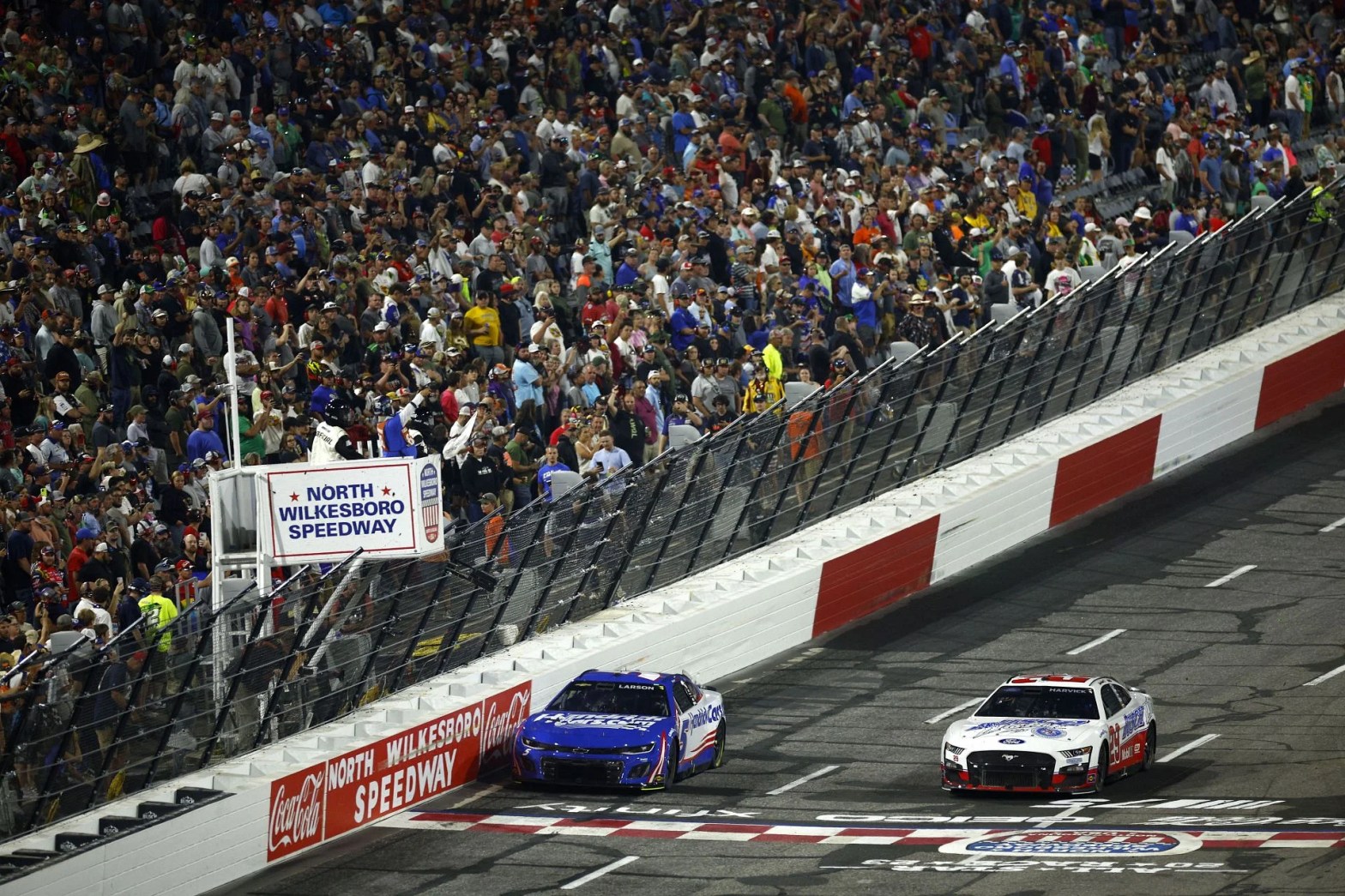
Castrol’s Gran Turismo-inspired Mustang Dark Horse locked the 2012 champ into the Playoffs last Sunday as well as clinching a spot in this week’s All-Star Race at the resurrected North Wilkesboro Speedway.
Repaved over the offseason, last year’s All-Star Race took place on the track’s worn-out 41-year-old pavement. Yes, the pavement was older than some readers’ parents.
Drivers rumble downhill toward the start-finish line until mashing the brakes and cranking the car into the tight 13 degree left-hander of turn 1. Between turns 1 & 2, the balance of the race car shifts over as the track winds its way onto the uphill backstretch.
Firing into turn 3 steeped at 13 degrees, drivers ride as close to the inside wall as possible for maximum grip through the corner before slipping downhill towards the finish line.
To make matters even more challenging, NASCAR assigned the race teams two separate sets of tires for use over the course of the weekend: a standard, harder tire and a new “option” tire made from a softer compound.
Teams are required to use both types of tires throughout Sunday’s festivities, starting with the All-Star Open featuring names such as Ty Gibbs, Bubba Wallace, and Alex Bowman.

The top-two finishers in the Open plus the winner of the Fan Vote advance to the 200-lap main event scheduled to broadcast on FS1 at 8pm ET.
NASCAR requires all teams to start the race on the softer “option” tire, marked with red Goodyear sidewall branding while the standard “Prime” tires carry the traditional yellow branding. And, if it rains, the Eagles came prepared with a white-sidewall grooved and treaded rain tire.
The race is due to have three segments with segment 1 ending after lap 50 while segment 2 concludes after lap 150, making the stage lengths: 50-100-50.
Last year’s winner Kyle Larson may not make it back in time from Indianapolis 500 qualifying to participate in the event, but his car will still get some laps around the track to tune it up for Sunday’s shootout.
Retired champion and current analyst Kevin Harvick hops behind the wheel of Larson’s #5 Chevy Camaro Saturday to practice the car in the fellow Californian’s stead.
With the weekend debriefing out of the way, this entry seeks to show how each race has played out in relation to the 10-year averages I measure every week as well as ripping into my writer’s picks thus far.
The Races

Of this year’s 13 races, 11 races haven’t exceeded the 10-year average of cautions at each track with Texas and Atlanta setting a higher bar and Las Vegas holding right to the average. Two races ran the same amount of laps under caution as the average, but a whooping seven fell beneath the average while just four landed above.
Except for COTA, every single race this season sailed far above the last decade in green-flag passes, especially at Las Vegas where an astounding 4659 passes took place over the race’s 267 laps.
This feels like a natural progression: less time spent under the yellow should produce more green-flag passing, but unfortunately at a track like Circuit of the Americas, that didn’t exactly play out for some reason.
Four races sunk into NASCAR Overtime at the end of the race, two less than last year by this point, yet the lap of last caution has increased in eight races, including each of the last two weeks going into the break.

Moving onto my writer’s picks, I have selected the winner of the event once this season when I selected Daniel Suárez to win Atlanta, but since then, I’ve been in a bit of a dry spell.
Thankfully, my record isn’t all bad. Though my correct pick was bracketed by two sub-30th-place runs, my picks notched top-10s in eight races and six of those were top-5s.
My picks’ average finish is 12.8, but they’ve racked up 421 points, placing them fifth in the drivers’ standings above William Byron and below Chase Elliott.
Since I leaving the oddsmakers out of it this week, we’ll be moving right along to the writer’s pick.
Writer’s All-Star Pick

Joey Logano is my pick to win the 40th annual All-Star Race
The two-time Cup champ sits on a winless streak dating back to past spring’s Atlanta race, and in dire need of momentum, I expect him to take command of this race early.
Roger Penske’s flagship driver participated in a tire test in the spring to better understand the track’s fresh new surface. That data becomes invaluable when the green-flag waves on Sunday night.
Scoring his first victory in this event way back in 2016 by holding off the hard-charging Kyle Larson, Logano looks to rip his #22 Ford Mustang Dark Horse around one of NASCAR’s original circuits.
 pitboxpress.com