

Yes, this is a very, very loaded title, but please bear with me.
Since the day I was born, I have been a NASCAR fan. That isn’t hyperbole, either. My father held me in his arms just hours after my birth and watched qualifying for the 1996 Dura Lube 500 in the hospital room.
Though my family tell me about how I knew the whole field, their numbers, names, and sponsors when I was just three years old, I don’t directly remember much prior to Dale Earnhardt Sr.’s passing at the conclusion of the 2001 Daytona 500.
My direct, lived knowledge of NASCAR begins at the 2001 Cracker Barrel Country Store 500 in Atlanta where Earnhardt’s replacement, Kevin Harvick, defeated Jeff Gordon by mere inches to score his first win.
I have been hooked from that March afternoon until this very day, and even after this weekend, I’ll be watching again next season. Perhaps that’s foolish of me considering how the sport treats itself and its fanbase, but the Daytona 500 is 97 short days away from now.
Time is of the essence, which is why I am here to propose changes to the sport with the platform that I currently hold.
How We Got Here

If I grabbed the reigns of NASCAR tomorrow, tackling the points system would be my first order of business.
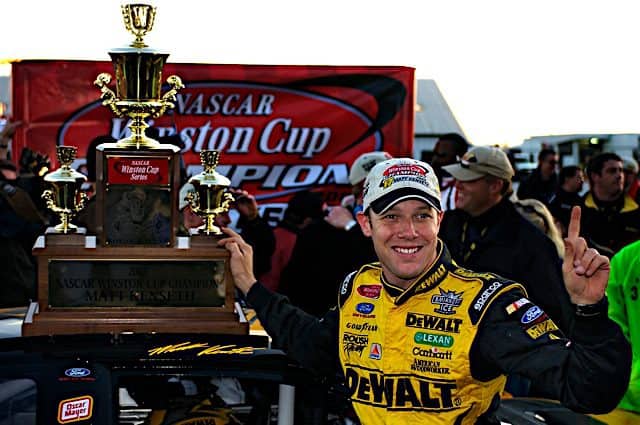
NASCAR’s silly attempts at creating a “postseason” emerged at the conclusion of the 2003 season where Matt Kenseth’s one-win campaign led to his maiden Winston Cup title.
Kenseth’s 2003 season often goes overlooked because of lack of moments where he proved himself to be the best driver in the series that year through winning or at the very least competing for wins.
The fourth-year driver led a lap in 17 of the first 29 races, finished in the top-5 on 11 occasions, and logged an impressive 25 top-10s that resulted in a 10.25 average finish over 36 races. Kenseth wrapped the title up in 35 races by finishing fourth at Rockingham before falling out early in the finale with engine troubles.
Conversely, owners were upset, specifically Roger Penske.
Penske’s driver, Ryan Newman, paced the Cup Series field with an astounding eight wins in 2003 en route to a disappointing sixth-place points finish. Penske appealed to NASCAR that their points format doesn’t encourage winning enough.
So, new NASCAR CEO Brian France made the decision to change the course of the sport forever.
France installed The Nextel Chase for the Cup where the first 26 races determined the top-10 drivers in points. From there, those 10 drivers were the only ones eligible to win a title over the season’s final 10 events.
Furthermore, the points from the regular season would be reset where the top points finisher would have their season’s worth of work erased entirely, sitting just five points ahead of second. Each driver would be separated by five points from the driver ahead of them.
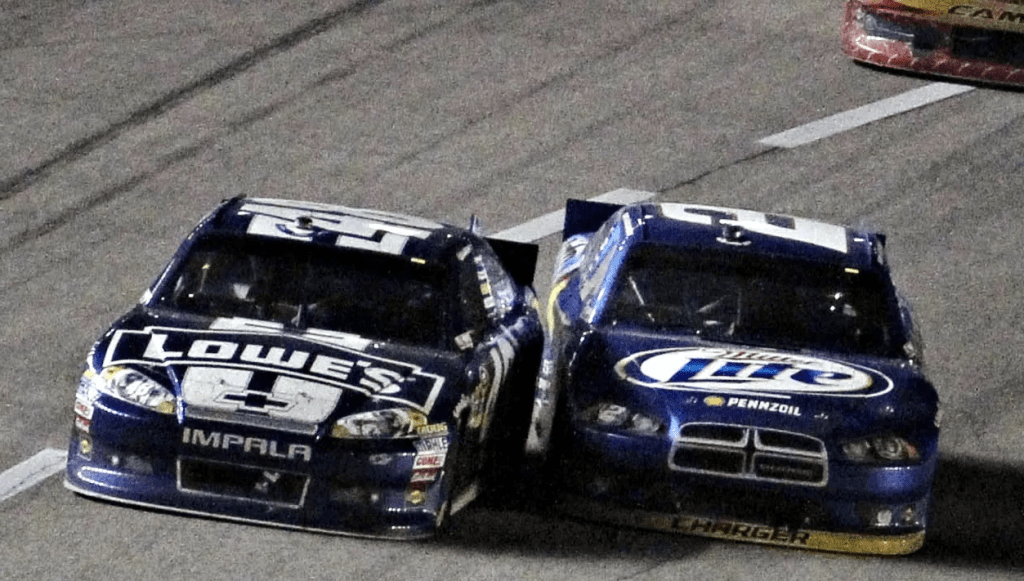
This system bucked naysayers in its inaugural season with Kurt Busch setting a new smallest margin of victory in a championship battle, eking by Jimmie Johnson by just eight points. With how points were tabulated at the time, that equated to just two positions on track in most cases.
Jimmie Johnson took this personally. He went on an unparalleled streak of five consecutive titles from 2006-10 where his #48 team looked practically unbeatable.
Johnson’s command on the format effortlessly bypassed changes made in 2007 to allow the top-12 points finishers into the Chase field and adding 10 points to each driver’s reset-point totals for each win they earned in the regular season.
At the end of Johnson’s fifth straight title in 2010, France made a second round of adjustments that saw the Chase qualifiers dropped from 12 back to 10 on points while adding two wild-card drivers from the 11th-20th spots in points based on how many wins they had.
2011 is where NASCAR started down the path of where we are today with the Playoffs as Tony Stewart — a winless driver in the regular season — went on an absolute tear in the postseason, winning half of the 10-race Chase to tie Carl Edwards in points at season’s end. Stewart came out on top due to winning more races.
A Brad Keselowski title the following year and a sixth Johnson title in 2013 prompted NASCAR to re-evaluate the points structure yet again.
Most of you are old enough to remember how the current Playoff format started, so I won’t chronicle that here for the sake of brevity. It is a convoluted mess for the sport that reared its ugly head yet again this season.
How would I change this?
There are two routes I’d explore: a return to the full-season points format with adjustments or a return to the 2011 Chase format with adjustments.
Full-Season Points in 2025?

If you hear people on social media tell it, this formula is impossible to institute in 2025 because the Playoff format is so ingrained into so much of what modern NASCAR has become.
This is in spite of the fact that Formula 1, IndyCar, IMSA, and numerous racing series over the globe still using a full-season points format to great fanfare.
I agree with The Captain: 2003’s NASCAR needed to incentivize winning more. That’s indisputable.
Back in 2003, a driver could win the race while earning the same points as the driver in second place if the second-place driver led the most laps. That’s patently flawed, which we accepted then.
Yet, we accept that this happens now.
With the advent of “stage racing” where the top-10 drivers are awarded points at the end of a stage, a driver could lead one lap the whole day — the final lap — and score less points than a driver that won both stages and finished 16th. This is patently flawed, and we should not accept this system.
Here’s my proposal:
- Stage racing remains in place as I don’t think that a lot of changes all at once would be respected by the fanbase because they hate how much things change as-is. Points will be doled out at the end of each stage to the top-10 just like they are now. Playoff Points are eliminated.
- The points earned for winning would be bumped up from 40 to 60 points. Winning in a series with a spec-race car is exceedingly difficult, and it needs to be rewarded properly. This also prevents anyone from below outpointing the winner. All other current point tallies for finishing position will remain.
- Crown Jewel races (Daytona 500, Coca-Cola 600, Brickyard 400, Bristol Night Race, and Southern 500) will run without stages and disburse elevated points because of this. Winners would be awarded 80 points for victory while runner-up collects 50 points with subsequent finishers drop one point to car ahead, which is similar to how points are tabulated now.
- Points would also be awarded for leading a lap and leading the most laps. Drivers will earn one (1) point for leading a single lap. If a driver leads the most laps, the driver is given three (3) points rather than one.
This system will reflect winning better than the 1975-2003 points system ever did while also rewarding drivers for big wins in big races. I would also introduce a program that would award the winner of three of the five Crown Jewels with a $3 million bonus. If a driver won all five, that award would rise to $10 million.
Chasing the Cup in 2025?
The 2011 version of the Chase for the Cup was a perfect blend of rewarding regular-season success while ramping up the intensity in the postseason.
I would still make a few adjustments to this format to make it better:
- Playoff Points will be disbursed to the winner of the race and each of the first two stages. Five (5) points for winning the race and one (1) point for winning a stage. These Playoff Points will be reallocated to the Playoff field at the beginning of the Chase and never again after that. Round racing is over.
- The Playoffs will be 12 races, expanding from 10 races. This will break up an already-long schedule a bit better as the Playoffs start at the 2/3 mark of the 36-race season.
- If you win five races and finish 21st in points after 24 races, then I’m sorry. You don’t make the postseason. The first 10 drivers in points will have an automatic bid to the postseason with two wild-card teams from the 10 drivers between 11th-20th in points with the most wins. If there’s a tie on wins, the highest points finisher between the two drivers will be selected.
- Playoff Points collected throughout the regular season will be re-allocated back to each team that earned them, including teams eliminated after 24 races. This allows everyone to benefit from Playoff Points at the end of the regular season to improve their points position over the season’s last 12 events.
- Crown Jewel races would run without stages to preserve the integrity and grit it takes to prevail. Instead, winners will be handed 10 Playoff Points for winning any of the five races listed in the previous section.
- Leading the most laps in a race would also earn a driver one (1) Playoff Point in addition to three in-race points. Leading a single lap (or more that doesn’t result in leading the most laps) will result in one point.
- Once the Playoffs start, stage wins will be converted into 15 points since Playoff Points only get allocated once at the beginning of the postseason. That way, winning stages remains a focus for both Playoff and non-Playoff teams.
- The champion will be crowned after the final race of the season where having the most points is paramount. Winning the title race gives you nothing extra if you’re still in contention to win the title other than the points bump.
- The points earned for winning would be bumped up from 40 to 60 points. Winning in a series with a spec-race car is exceedingly difficult, and it needs to be rewarded properly. This also prevents anyone from below outpointing the winner. All other current point tallies for finishing position will remain.
In this format, winning is heavily weighted, but it isn’t enticing teams to give up at any point in the season because one great day could turn your whole season around.
A trip to the postseason is not guaranteed by strong, but spotty performances. A trip to the postseason isn’t tainted by drivers that ran laps down most of the year winning a race at a superspeedway. A trip to the postseason isn’t circumvented by winning at opportune times, or winning period.
Eliminations sound cool, but they aren’t necessary. Drivers will be naturally eliminated if they are too far behind in points, which is interesting to cover in its own right.
Conclusion
Neither of these proposed formats would face anywhere near the criticism that the current Playoff format provides. Would problems of their own be created? Of course, and I would tweak the rules to adjust for them.
The France family (and NASCAR as a whole) got complacent with this format, and now, we have Joey Logano winning the title with the most efficient title campaign the sport has ever seen.
A driver with a 17th-place average finish should hardly be in the postseason, but they certainly shouldn’t be rewarded for finishing outside the top-10 in half of the Playoff races because they won the first race in a round.
Sometimes, your format isn’t broken, but you change it anyway. Other times, the format is broken, and the sanctioning body try to tell the fanbase that “we like what we’re seeing” and “response from our fans is overwhelmingly positive”.
Yesterday’s reaction at the track and online appear to differ from the series’ executives. With that being the case, it’s time for NASCAR to make a change. Hopefully, it looks better than what we currently have.
(This is part of a larger series that I’ll be adding to over the course of the offseason. The next installment will cover how I would adjust stage racing in 2025.)
(Top Photo Credit: Nigel Kinrade/NKP)
 pitboxpress.com