After a grueling 35 weeks of racing action, the conclusion of the 2024 NASCAR Cup Series season is upon us this weekend at Phoenix Raceway.
Four drivers remain eligible to win the title — Joey Logano, Tyler Reddick, Ryan Blaney, and William Byron. Before they take on the daunting dunes of the Desert Diamond, let’s see how they got here.
Last Week at Martinsville
Martin Truex Jr. started the day on pole and brought the field down to green for the Xfinity 500, the final race in the Round of 8. For the first 40 laps, Truex held the lead over Chase Elliott before the #9 ducked inside of the #19 on lap 42 and finished the pass off in turn 4.
Elliott lapped a number of cars before trouble met one of the six remaining title contenders. Christopher Bell lost his #20 Mobil1 Toyota Camry underneath the lapped car of Corey Lajoie in the middle of turns 1&2 on lap 77, resulting in the race’s first caution.
The spin was just the start of the #20 team’s issues as a loose wheel on a later pit stop put them behind the entire field on a restart, leading to the title favorite coming into the day falling a lap off the pace.
Bell never recovered the lap during the stages, leaving the fifth-year racer unable to make up spots (and thus, points) to put himself back into a position to advance. As a result, he hoped that none of the Playoff crop claimed the victory as it would put him in a points battle with Byron and Byron’s teammate, Kyle Larson.
All was going exactly as planned for the Hendrick Motorsports’ entries as their Playoff cars occupied three of the top-6 spots at the end of stage 1 with Elliott staving off the challenge from Byron.
Little did they know their biggest threat was inching his way closer and closer to the front with Ryan Blaney’s Discount Tire Mustang nudging any and all opposition out of his way to a fifth-place result in the first stage.
Not long after the green flag introduced stage 2, Daniel Suárez went for a ride into turn 1 when a stack-up saw his #99 Jockey Chevy spin after contact from behind, courtesy of Austin Cindric on lap 131.
Just seven laps after the race went green, Carson Hocevar’s interesting day kicked off in a big way when he made contact with the struggling Harrison Burton going into turn 3, sending the summer Daytona winner sliding up the track to bring out the race’s fourth caution.
The field couldn’t wait to bring out the yellow with two more quick cautions flying, both of which finding Kaulig Racing’s Daniel Hemric involved. One was in a collision that spun out Truex before getting the sore end of Hocevar’s aggression in turn 1 after only 12 laps clicked off the board.
With over half of the stage spent under yellow by lap 200, the race went caution-free for the rest of stage two as Brad Keselowski held off a charging Ryan Blaney to nab his first stage win of 2024.
As the final stage went green, six drivers remained in contention with drivers in must-win situations — Ryan Blaney, Chase Elliott, and Denny Hamlin — all jostling for position in the top-10.
Blaney’s ascent to the front would not be denied as a fight for second broke out between himself, Byron, and the lapped car of Shane van Gisbergen.
With 156 laps left on the board, Blaney played a game of 8-ball pool where he acted as the pool cue, popping van Gisbergen’s white Chevy into Byron, forcing the #24 car up the track in turn 1. The move allowed Blaney to sneak by on the bottom as Byron struggled with his handling the rest of the race.
After green-flag pit stops, Chase Elliott commanded the race on a daring two-stop strategy to tackle the final stage, hoping to maximize his tire life while sacrificing track position.
Right as Byron made his way to Elliott’s bumper, a caution flew on lap 398 following contact between Alex Bowman and the lapped Carson Hocevar machine that sent Hocevar’s #77 spinning in turn 2.
The flag couldn’t have come at a better time for Elliott as it allowed him to get back on the same strategy as the rest of the leaders, or so he thought.
In order to keep Christopher Bell a lap down, Larson, Byron, and a host of others stayed out on their 30-lap-old tires, thus sacrificing any chance they had of winning the race themselves.
The first cars with fresh tires were Brad Keselowski and Denny Hamlin in row 3, though they only had fresh right-side tires while Elliott and Blaney lined up behind them with four fresh stickers.
Coming out of turn 4 for the restart, the commentary noticed a rogue tire on the race track, urging NASCAR to wave off the restart. The wave never came as the green flag fell for all of about 400 feet.
Kyle Busch’s pit crew failed to screw on his right-rear tire securely, leading it to be picked up by track safety personnel under the race’s ninth and final caution. The quick burst before the yellow put Blaney even further back with timing and scoring listing him in 10th for the final restart, sending him into a fury on the radio.
Thus began Blaney’s march.
Over the final 87 laps, the defending series champion sliced and diced his way through the heart of the Cup Series grid, passing the likes of Denny Hamlin, Brad Keselowski, Kyle Larson, William Byron, and finally Chase Elliott with 15 laps to go to snag his third win of 2024 and his second-straight fall Martinsville victory.
Instead of the focus being firmly placed on Blaney’s drive, shenanigans were afoot.
Over the final 20 laps, collusion and corruption were the name of the game for Chevrolet as William Byron’s ill-handling car on older tires began to fade as the laps wound down.
Byron sat in sixth place, just one point to the good over Bell. Chevy drivers Austin Dillon and Ross Chastain approached rapidly on fresher tires, but instead of easily maneuvering around the #24, the #3 and the #1 just stayed behind Byron side-by-side for the final 13 laps.
Essentially, the Bowtie Blockade was developed with lapped cars Justin Haley and Carson Hocevar lending their help to the battle as well since they drive for the Hendrick-affiliated Spire Motorsports.
With five laps to go, Bubba Wallace reported an issue to his team over the radio that made his car fail to grip up into the corners, so even though he was mashing the gas on the straights, he couldn’t make the corners.
As Wallace’s Toyota faded, this gave hope to Bell as his Mobil1 Camry came to life on the final run, being within eyeshot of Byron and Wallace with limited time remaining.
Chastain and Dillon minded their Ps and Qs, electing to not race Byron over the final laps to allow one Chevy to make the championship race…or so, we thought.
On the final corner of the final lap, Bell fired his Toyota into turn 3 to pass Wallace, but he got caught in the tire marbles of the upper grooves and slid into the fence. Despite pedaling the car to try keeping it off the wall, it was clear to anyone with eyes what the incident looked like.
Finally, after almost 30 minutes of deliberation, Christopher Bell was deemed to have ridden the wall in a style similar to Ross Chastain’s Hail Melon move from 2022.
That maneuver is now illegal, and despite not shifting into fifth gear and taking his hands off the steering wheel while he mashed the throttle down, Bell was found guilty of a safety violation, losing his position to Wallace in the race and his championship position to Byron in one fail swoop.
In the aftermath of the infraction, it was revealed that Chevy setup “a deal” between some of its other drivers to help the three Hendrick cars make the Playoffs should their be a situation where their help might be useful.
Though Bell’s move was only faintly reminiscent of Chastain’s, his onboard camera proves that he didn’t mash the throttle when he was in the wall, he braked plenty when getting into the corner, and his “wall ride” didn’t produce any results as he lost time to cars behind him on track, namely the #48 of Alex Bowman.
The worst part for Bell, which he acknowledged in a Saturday media session in Phoenix, is that he wouldn’t have slid into the wall or even had to pass Wallace if the Chevys ran the race naturally.
NASCAR handed penalties to Dillon, Chastain, and Wallace, fining each driver $100,000 and 50 driver points while having their teams gutted this week for Phoenix by removing their crew chiefs, spotters, and one team executive.
Instead of matching precedent for the race manipulation penalties that came from Spingate in 2013, Byron’s bid was unchallenged by NASCAR, letting him advance to his second title race in a row.
The News
23XI and Front Row Motorsports went to court against NASCAR this week to deliberate over a preliminary injunction that would allow 23XI and FRM to run as chartered teams next season due to the injunction removing a clause in the charter agreement that doesn’t allow teams to file suit against the sport itself.
Judge Frank Whitney determined Friday that the teams only discussed possible harm should they elect to run as open teams instead of irreparable harm that has already been done as a result of not signing the charter.
According to Fox Sports’ Bob Pockrass, the teams’ attorney, Jeffrey Kessler, said, “Although we are disappointed that the preliminary injunction was denied without prejudice and as premature, which we intend to appeal, this denial has no bearing on the merits of our case.
“My clients will move forward to race in 2025 and continue to fight for a more fair and equitable system in NASCAR that complies with antitrust law.”
Track History & Layout
After years of open-wheel racing and regional stock-car events, Phoenix Raceway opened its doors to the NASCAR Cup Series in 1988 where Alan Kulwicki snagged his first career victory and performed what became known as “the Polish Victory Lap”.
It took nearly two decades for the track to get a second race weekend with a spring date being added in 2005. Since then, the track has hosted the Cup and Xfinity Series twice per season, and in 2020, it began hosting NASCAR’s season finale.
Kulwicki may have been NASCAR’s first Phoenix winner, but Kevin Harvick made the track his own.
Harvick took his first victory at Phoenix in 2002 in the Truck Series, and he repeated the feat the following year, both wins coming for his own team. Harvick went on to sweep the 2006 spring Phoenix weekend, winning both the Xfinity and Cup races there.
In all, Harvick won four Truck Series races, one Xfinity race, and nine Cup races at the Desert Diamond, ending his career with a streak of 21 consecutive top-10 finishes.
But enough about history, let’s talk about this coming Sunday at Phoenix Raceway where the stars of the Cup Series wade through the sandy slopes of the Estrella Mountains.
This flat, one-mile oval’s turns are sharp, but the amount of ways around them are infinite. The banking starts at 8° on the bottom before moving to 9° on the high side until reaching the backstretch where the field will drag race into the last set of corners.
Turns 3 & 4 offer variable banking as well, standing at 10° on the bottom and climbing to 11° midway up the banking until reaching the start-finish cactus that opens up to the Dogleg.
Older fans remember the Dogleg as a cute, grassy element, added to the track to give it a little character. Since the reconfiguration in fall 2018, the Dogleg received a major overhaul.
The Dogleg itself went from being flat to an 11° bank, allowing cars to carry more speed into Turn 1. Alternatively, drivers can duck onto the additional pavement on the flat apron where they’ll try to cut some time and distance off their lap to get ahead of the competition.
Because of the Dogleg’s placement, restarts are especially calamitous, allowing drivers to spread out as low as the pit lane wall, but if someone goes super low, they had better know how they’re exiting Turn 2.
Weather & Fast Facts
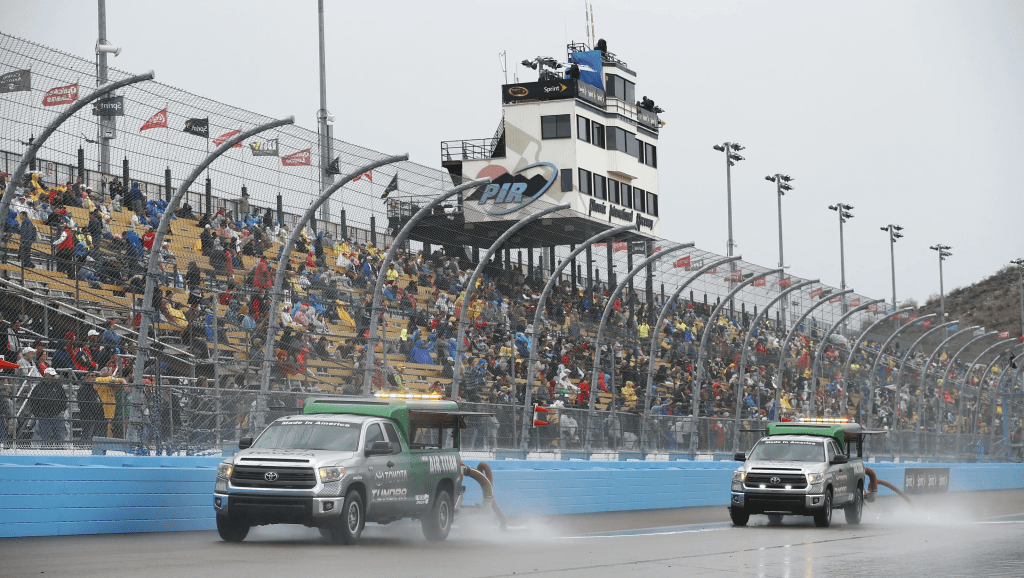
It’s the desert, and unlike 2020, there won’t be any rain!
The race won’t start in the heat of the Arizona day, so 75°F temperatures to start the race won’t be permanent as the weather moves into the low 80s around 3pm local time. By that time in the race, the drivers and teams will be finishing stage 2, meaning the final stage of the season will take place at the hottest time.
As for the average Phoenix fall race over the past decade, it looks something like this: 7 cautions for 42 caution laps, 13 lead changes, 1,638 green-flag passes (6.1 per green-flag lap), and a lap of final caution falling around lap 282 or with 31 laps remaining.
Today’s title race will air on NBC with pre-race coverage starting at 2pm Eastern Time. Like many races in the desert before it, this race will run for 312 miles over 312 laps, making the race a 500-kilometer event. The race will be broken into three stages ending on laps 60-185-312.
Over the past decade, the fall Phoenix race has seen NASCAR Overtime just once in 2016, and with the race starting a little after 3pm Eastern time, I’d recommend not making plans until after 6pm to either celebrate or drown your sorrows.
Writer’s Pick
I picked Blaney the last two weeks, and after picking him several times throughout the season, I finally got one right as he collected his second Ridgeway Grandfather clock.
I’m sticking with him for the finale as well.
Last year, I was in Phoenix for the title race to see Blaney claim his first Cup Series championship. Though I won’t personally be there for the first time since Phoenix started hosting the finale in 2020, I believe Ryan Blaney is the best of the four drivers at Phoenix.
Blaney holds an active streak of six top-5s coming into the weekend and was fastest in practice in single-lap, 5-lap, and 10-lap averages on Friday. He has finished no worse than fifth at Phoenix in the NextGen era.
After a decade of this series seeing no repeat champions, today is the time for that to end.
(Top Photo Credit: Patrick Vallely/Pit Box Press)
 pitboxpress.com