
Before we roll into the Irish Hills for this weekend’s race at Michigan International Speedway, let’s take a brief look at what happened in the previous installment of the NASCAR Cup Series.
Last Week at Richmond Raceway…
An event brimming with possibility dominated the headlines coming into Richmond as NASCAR emerged from a three-week absence due to Olympics coverage on NBC.
NASCAR collaborated with Goodyear to bring two different sets of tires to the race track. When it comes to tire wear, the powers that be could not have possibly chosen a better track to test this experiment.
Joe Gibbs Racing ruled stage 1 with pole sitter Denny Hamlin holding the lead for the race’s first 45 laps before Christopher Bell skipped by, leading to series-leading 10th stage victory of 2024.
The beginning of the second stage offered the first break from traditional strategy.
Daniel Suárez and Michael McDowell serviced their cars during the break and made NASCAR history as the first drivers to run an option tire in Cup Series competition.
The extended second stage stretched out over 160 laps, allowing this strategy to potentially benefit the #99 and the #34; needless to say, it worked out.
McDowell climbed from the last car on the race track for the restart to seventh place before ducking into pit road to saddle his ride with a set of prime tires after 40+ laps on the reds.
Suárez took it much further than McDowell. Silently running solid lap times in the top-15 in stage 1, Suárez’s gripped up much better than any other driver, making daring passes all over the track.
The Choice Privileges Chevy Camaro sprinted by Hamlin’s FedEx Rewards Toyota Camry on lap 92, just 12 laps into a run where he restarted 15th. Crew chief Matt Swiderski’s brilliant call gave his #99 team track position that he wouldn’t relinquish, gapping Bell in the third tire run on his way to a stage 2 victory.
In that time, Austin Dillon’s camo-coated Bass Pro Shops Chevy methodically picked his way through the field, showing impressive long-run pace and climbing his way to fifth at the stage break.
Other notable moments included pit road miscues put Chris Buescher and Kyle Busch down a lap for much of the evening, barring them from earning stage points to erase their gap to the Playoff bubble.
Strategy would flip for Suárez on the stage 3 restart as most of the lead-lap cars stockpiled their sets of reds until the end of the race. The move put the Trackhouse driver on an alternate pit sequence to the rest of the field and kept their playbook open for the rest of the night.
Despite leading the next 46 laps, Bell’s night unraveled on the first round of green-flag pit stops when he was assessed a speeding penalty on pit road.
The move to the red tire and Bell’s penalty removed one more competitor in Austin Dillon’s quest for glory. The red tires really made the #3 car come to life, wrapping the center of the corner better than anyone else in the entire field.
Crew chief Justin Alexander called a perfect race to that point, adjusting the car to Dillon’s liking and watching his driver weave through traffic at the Action Track.
Dillon slithered by Hamlin on lap 333, pushing the #11 team to pit before the lap completed. A smooth, four-tire pit stop from the FedEx crew was the conduit to a perfectly executed undercut, even though Dillon stopped just one lap later.
Much of the final run was spent watching Dillon track down Hamlin’s Toyota. Just 25 laps later, Dillon assumed the lead after a multi-lap, side-by-side duel with the successful veteran with 29 laps to go.
In the background, Daniel Suárez and Ryan Blaney took a gamble.
The reigning champion retreated to his stall for reds after a so-so day for the #12 team, and within 20 laps, Blaney got back on the lead lap and started chewing his way through the field on aged yellows.
Suárez presented an even bigger challenge. The former Xfinity Series champion took four fresh reds with 40 laps remaining, stampeding through traffic at an absurd rate.
At certain points, Suárez ripped chunks of up to a second out of the gap each and every lap, rising all the way to the top-10 with less than 20 laps to go.
Daniel’s bid fell short though, his red tires hitting a steep cliff on lap 35 where the falloff on his tire equaled out with the yellows in sixth place. That all but sealed the win for Austin Dillon.
Until Ricky Stenhouse objected.
Stenhouse plowed over Ryan Preece — not for position — on the entry to turn 1 on lap 399, bringing out the first caution for cause of the event and forcing every lead-lap car onto pit road.
The good news for Dillon was that Alexander saved his driver a set of reds for this exact situation, but so did most of the top-15. Dillon’s Bass Pro Shops bunch logged a solid stop and put their driver at the front of the field for the race’s last two laps.
Dillon chose the inside for the restart and gave up his lead almost immediately to Joey Logano on the outside, and for the next lap-and-a-half, it looked like the #22 team pulled off another clutch win.
Then, Austin Dillon “did what he had to do.”
Dillon shifted up a gear and held the throttle open until he met Logano’s bumper, turning the two-time Cup champion around in the race’s final turn.
Cool as a cucumber, Hamlin appeared to have avoided the calamity, maintaining the racing line at the bottom of the track on the way to certain victory after leading the most laps.
Then, Austin Dillon “had a reaction.”
The camo car bolted down the track from three grooves up and unabashedly wrecked Denny Hamlin. Dillon drove straight into the #11’s right-rear quarter panel under caution on a straightaway, cleaning the Toyota out before straightening his Chevy en route to one of the worst finishes in the history of the sport.
A night brimming with promise brought down because NASCAR can’t get out of its own way.
The News
The NASCAR penalty report was released a bit later in the week than usual with punishments being handed down to both Joey Logano and Austin Dillon.
Logano received a $50,000 fine for his reckless behavior on pit road after the race where he drove around a horde of people from Austin Dillon’s team and did a burnout near them. Logano implied in interviews this weekend that he had control of his car the entire time and posed no threat to anyone.
NASCAR docked Dillon 25 driver and owner points and stripped him of his Playoff eligibility after his conduct on the last corner of last week’s race. NASCAR deemed Dillon breached the NASCAR code of conduct, asserting the #3 car’s actions on the last lap were detrimental to the sport of stock car auto racing.
Dillon and Childress will be appealing the penalty but not the penalty assessed to spotter Brandon Benesch. The spotter was suspended for the rest of the regular season because of his conduct on the radio.
Trackhouse Racing announced the re-signing of their first driver, Daniel Suárez. The two-time Cup winner notched his first win in 2022 at Sonoma and earned a top-10 points finish before dipping in performance the following year and missing the postseason.
Suárez came into 2024 with a lot to prove in a contract year, and he delivered with prudence, running a masterful race in Atlanta and claiming his second career Cup victory in legendary fashion by narrowly scooting by former champions Blaney and Kyle Busch.
The move solidifies two of Trackhouse’s supposed three-car lineup for next season. No one has been announced for the seat, but Bob Pockrass reported that Shane van Gisbergen is expected to pilot a third Trackhouse entry full-time in 2025.
Michigan’s History

Though the circuit was constructed under the ownership of Detroit land developer Lawrence LoPatin in the late 1960s, Roger Penske bought the large 2-mile oval for roughly $2 million in 1972 and brought the facility with humble beginnings into the modern day.
Penske’s Michigan Speedway improvements consisted of adding grandstands and consistently evolving the spectator experience, birthing a raucous camping culture in the infield that remains rowdy to this day.
During the 1990s, the American open-wheel split put Michigan in the limelight for all the wrong reasons as CART held a counter-protest event of the IRL’s Indy 500 billed as the US 500.
Without getting too deep into it, that race was an unmitigated disaster and became an early omen for the future health of CART.
Roger Penske decided to merge his track-ownership business with NASCAR’s International Speedway Corporation in 2000, ceding controlling interest in all of his facilities over to the sport.
Since NASCAR’s purchase of Michigan, the track went through a flurry of infield and press box renovations in the mid-2000s before dwindling attendance and rain-affected races saw a once-great palace of speed lose one of its two race dates after 2020.
This followed a capacity reduction in 2018 that brought the speedway down to a leaner 56,000-seat facility, a far cry from its heyday where it crammed over 130,000 into the venue twice every season.
In the first iteration of this event back on June 15, 1969, Cale Yarborough outdueled LeeRoy Yarbrough’s dominant Junior Johnson Mercury in the final laps to notch his 11th career victory in NASCAR’s premier stock car division, his first of eight wins in the Irish Hills.
Second-place finisher David Pearson ultimately developed into the most successful driver in the history of the track, locking down a record nine wins and claiming all but one of them with Yarborough’s former team, the illustrious Wood Brothers Racing.
Kevin Harvick nabbed six wins at Michigan in modern times, but the active wins leaders are Joey Logano and Kyle Larson with both champions scooping up three victories in the Wolverine State.
The Track
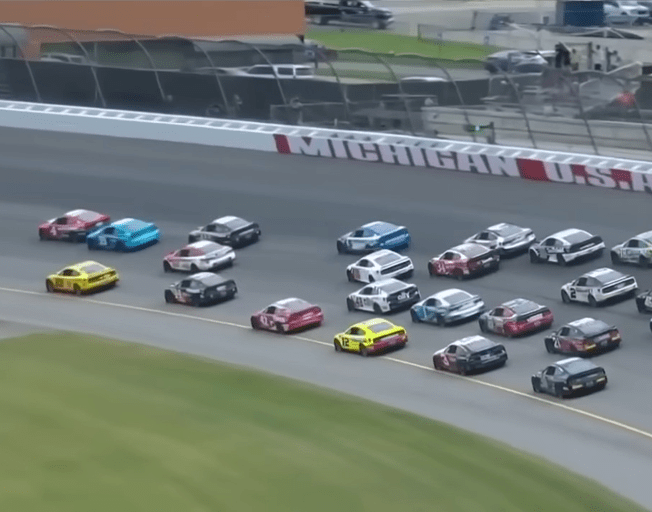
With the removal of its sister track, Auto Club Speedway, Michigan International Speedway in Brooklyn, MI stands as the fastest oval on the NASCAR calendar.
This 2-mile D-shaped circuit saw Christopher Bell lay down an insane pole lap last year, averaging 193mph for the long trip around MIS.
Drivers throttle up through the exit of turn 4 and enter the curved frontstretch. Banked at 12°, the wide front straight stretches out to 73 feet. Wide enough as it is, drivers can take to the 12-foot apron to cut distance off their lap and make more time.
The front straight keeps speeds up into turn 1 where the slopes grade up to 18°, much higher than Auto Club’s 14° banking. The track width stays consistent around the track, allowing drivers opportunities to fan out in the corners and run different lines.
On the exit of turn 2, the track narrows up, often the site of multiple incidents throughout a race weekend. A relatively flat backstretch extends for 2,242 feet and gives drivers passing opportunities as they surge towards the treacherous turn 3.
Much like Richmond before it, Michigan’s turn 3 narrows up, forcing drivers to slow down more on corner entry before they put their foot back on the gas pedal.
The banking remains 18° through the turn, and paired with a corner exit that merges into the curved front straight, this allows the draft to be extremely powerful as they haul the mail into turn 1.
Weather & Fast Facts
If you watched the Xfinity race yesterday, the weather wasn’t exactly on NASCAR’s side; the same could be said for today’s forecast.
The fine folks at AccuWeather show a 55% chance of precipitation in the area on race day, including a thunderstorm, so if you’re at the track, dress and travel accordingly.
When it isn’t supposed to rain today, the track will be completely shrouded in cloud cover, dropping the temperature down to a moderate 76°F before dipping to 65°F in the evening.
Here’s how the average race plays out over the last 10 summer races at MIS: 7 cautions for 32 caution laps, 17 lead changes, 2,829 green-flag passes (16.8 per lap), two instances of Overtime, and a final caution occurring on lap 172.
Today’s Firekeepers Casino 400 will run for 200 laps over 400 miles, and on average, the race ends just 2 hours and 42 minutes after the initial green flag, making this one of the quickest races on the Cup schedule.
USA Network gets behind the camera to broadcast the event with the NBC booth with coverage starting around 2:30pm Eastern time. Today’s race is split into three stages ending at the following laps: 45-120-200.
The Odds

Kyle Larson (+450) leads the DraftKings betting favorites for this weekend’s event. A three-time winner at Michigan, Larson outdueled fellow young gun Chase Elliott back in 2016 to claim his long-awaited first Cup victory at this track in 2016.
The win snowballed into three-straight victories in the Irish Hills, including an insane three-wide pass on the final restart to steal the win in summer 2017. Larson has come close here since his brief domination, and after going on a heater in his sprint car, I wouldn’t be surprised to see Yung Money cash in today.
Right behind him is a familiar foil for Larson, Denny Hamlin (+550). Though he claimed back-to-back spring race victories here in 2010 and 2011, the Virginian has fallen just short of victory lane here in the time since.
The 43-year-old Joe Gibbs Racing pilot races into the Wolverine State with controversy in his rearview mirror; this is usually when Hamlin is at his best. Seeking to end a 9-race winning streak at the track by Ford, Hamlin’s Toyota returning to Michigan victory lane is entirely possible as he starts today on the pole.
Defending Cup Series champion Ryan Blaney (+1000) rolls into Michigan as a former winner of this event. Taking the lead on a late restart, Blaney held off William Byron and the Hendrick Chevys to keep Ford’s streak alive and well in 2021.
Fond of winning at tracks where cars reach high top speeds, Michigan shapes up well for Blaney. In his last nine starts here, the Team Penske driver fell out of the top-10 just twice, and in 2020, his own teammate took him out racing for the lead. Expect Blaney to contend today in his title-clinching Dutch Boy/Menards scheme.
As for the two top drivers outside of the Playoffs right now, my eyes are on Chris Buescher (+1300) and Ross Chastain (+1000). Buescher put on a show last year, holding off Martin Truex Jr. on a Monday to win. In need of a great run, the RFK racer could rebound in a big way today with a victory.
Ross Chastain has run well here in the NextGen era, but he doesn’t always have the results to back up his performance. United now with Kevin Harvick’s old sponsor Busch, Chastain’s beer buggy might have the extra little bit of speed necessary to find victory at NASCAR’s fastest track.
Writer’s Pick
Last week’s pick was Martin Truex Jr. The less said about Joe Gibbs Racing’s valve springs, the better.
On the other hand, this week’s pick relies on JGR Toyota engines…(perhaps I should re-think it, but what’s the fun in that?)
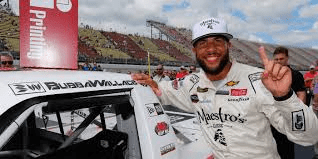
Bubba Wallace (+2000) holds an impressive record at Michigan, and if it weren’t for Kansas Speedway, the 23XI flagship driver could reasonably call this his best track.
The site of his thrilling Truck Series win in 2017, Michigan holds even more significance for the Alabama native as it’s the site of his first Cup Series pole position back in 2022.
Bubba spent the entire race up front and came up one spot shy of glory (and a Playoff berth) that day, but he starts close to the front yet again, rolling off the grid in fifth.
With so much going Wallace’s way in recent weeks, it’s hard to imagine he won’t contend at one of his best circuits, so I’m locking in my pick to win the race and lock himself and the McDonalds team into the Playoffs.
(Top Photo Credit: Sean Gardner/Getty Images)
 pitboxpress.com