
The fierce, revving engines of the NASCAR Cup Series sat dormant over the past few weeks while the Olympics took center stage in the world of sports.
Let’s take a look back at what happened before the break in the great city of Indianapolis.
The rejuvenated Brickyard 400 saw the green flag with pole sitter Tyler Reddick sprinting out to an early lead that lasted through much of the first stage.
Indy’s first stage brought nothing of note on the race track. As for the control tower, they were a bit more notorious, hitting Chase Elliott and Brad Keselowski with blending penalties when both drivers grazed the track surface in the short chute between turns 1 & 2 after their first green-flag pit stops.
Multiple drivers spoke out on the radio about NASCAR’s messaging in the rulebook as well as the video they were shown in the drivers’ meeting, though the final ruleset (released on Saturday afternoon) stressed that drivers must not occupy the racing surface between turns 1 & 2.
Reddick’s car owner, Denny Hamlin, assumed the lead at the conclusion of the pit cycle and picked up a win at Indianapolis, but only a stage win.
Stage 2 offered a bit more in terms of pit strategy and competition as teams made sure that they kept their cars out front for as long as possible, a result of the track’s layout making it difficult for these cars to make passes.
A debris caution on lap 70 put the race under its first natural yellow and shook up the field again, shuffling several cars that spent the first half of the race up front into the midpack.
The green flag flew for close to 30 seconds, interrupted by a collision on the backstretch triggered by contact from Stewart-Haas Racing teammates Chase Briscoe and Ryan Preece with William Byron, sending the latter’s Hendrick Motorsports Chevrolet into the outside wall and into the path of AJ Allmendinger and Harrison Burton.
Though those three cars had their days ruined, Bubba Wallace’s day was just getting started.
Already the owner of multiple top-10s on the oval, Wallace’s Air Force Toyota scooted into the distance when in clean air, leading the entire second-half of stage 2 en route to his first stage win of 2024.
From there, the race changed dramatically.
Much like the previous multi-car wreck, the field failed to make it through one whole lap around the Brickyard’s 2.5-mile complex without bringing the caution flag out.
This time, Martin Truex Jr. attempted to run Kyle Larson out of room on the backstretch and found himself bumper first into the turn 3 wall when Larson’s #5 muscled the 2017 champ out of the way.
In the aftermath, Ty Gibbs cleaned out Josh Berry, knocking out his #4 Caitlin Clark car. The next restart would begin the race’s undoing.
Carson Hocevar received a massive shove on the frontstretch from Austin Cindric, giving the rookie a full head of steam heading into turn 1. Right before the cars were set to dive into turn 1, Hocevar’s nose peeked between the cars of Ryan Blaney and Austin Dillon.
Blaney got cleared down by his spotter going into turn 1, cutting across Hocevar’s nose, and wrecking both Joey Logano and Jimmie Johnson in the melee.
Hocevar came under fire for the contact on social media, but the NBC booth showed angles absolving the young driver for the contact. The ensuing restart led to a short green-flag run before Truex’s car decided to redo its spin from 20 laps before in turn 3, bringing out the race’s seventh caution.
This is when Kyle Larson won the race.
The HendrickCars.com team loaded his car full of fuel, allowing the reigning Indianapolis 500 rookie of the year to storm through the field over the event’s final 30 laps.
From that point onward, the race broadcast split between two screens: one showing us the battle for the lead between Brad Keselowski and Ryan Blaney — both saving fuel — and another focused on Larson slicing through the vulnerable pack.
Laps ticked off the board, calculators clicked, and fuel flowed through the cars drop-by-drop to propel them closer and closer to the finish. Keselowski wanted desperately to win his second Brickyard 400, this time driving for himself at RFK Racing.
Blaney swung into the summer with a wave of momentum on his side, winning at Iowa and the week before at Pocono. With team owner and track owner Roger Penske in attendance, it would be one of the biggest victories of the reigning champion’s career.
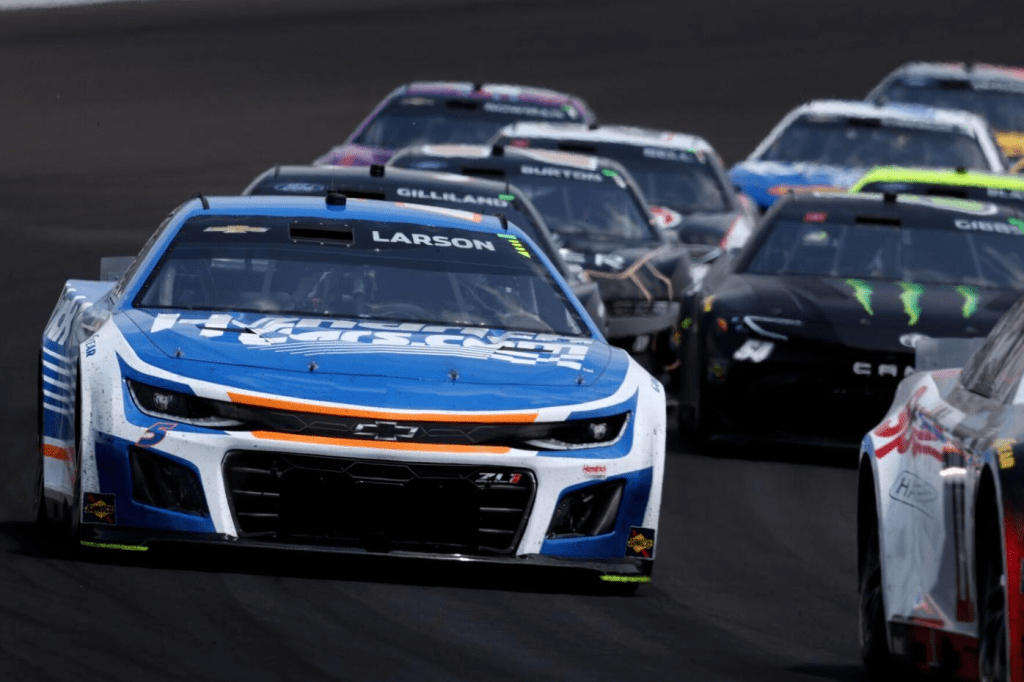
Then, there’s Larson. His Indy-Charlotte double attempt from the spring was foiled by inclement weather in both locations, meaning he never got to pilot his #5 papaya-tinged Chevy in competition.
Rick Hendrick brought that paint scheme back for the Brickyard in hopes it would inspire the #5 team to plant their flag at a facility that HMS has dominated for much of stock car racing’s history at the famed circuit.
With the three leaders nose-to-tail with three laps left, it looked like fans were about to be treated to a fantastic finish that they’d be talking about for years, perhaps decades to come.
Instead, Kyle Busch sent it into turn 3, spun himself off the side of Hamlin, and glanced the outside wall.
To make matters worse, Brad Keselowski — the leader of the race — crept onto pit road as the cars were lined up and ready to go back green, moving the entire inside row up a spot.
This meant that Ryan Blaney was supposed to be the control car. The restart that followed didn’t exactly support that he was the control car; regardless, Kyle Larson jumped out to the lead on the restart and would have won the race had John Hunter Nemechek not thrown a block for 13th place and caused a pileup.
A 20-minute red flag delayed the inevitable. Larson was not penalized for the questionable restart. He took the lead on the final restart and never looked back.
And, neither did NASCAR, apparently.
Ryan Preece’s wounded Ford sat on the backstretch — on the racing surface — for almost 40 seconds before race control threw the caution and ended the race. In theory, there should’ve been another restart, but NASCAR withheld the flag and effectively handed the 2021 champion his fourth win of 2024.
The News
Corey Lajoie’s 2024 season can be defined by many words in the Oxford English Dictionary, but the one I am going with is disenchanting.
Coming into the season, Lajoie proudly proclaimed on his podcast that the team would be disappointed if they weren’t contending for a Playoff spot when September rolled around.
Sitting outside the top-25 in points spurred Spire Motorsports to make a driver change for next year, opting out of Lajoie’s contract for 2025 to bring a fresh face to the seat, leaving Lajoie unemployed after November.
For a synopsis of Lajoie’s season to this point, you can read my article from two weeks ago about possible replacements for the embattled veteran for 2025.
Netflix re-upped with NASCAR for another season of NASCAR: Full Speed to debut sometime next season, but due to the ongoing charter talks, teams might balk on participating until a new deal is complete.
Speaking of deals that can’t get done, the elusive Cup Series schedule for 2025 that was initially teased to release all the way back in May before the Coca-Cola 600 is still not out. The best that has been unearthed is a “draft” of the Playoff schedule for next season, reported by Jordan Bianchi of the Athletic.
If you haven’t exactly stayed plugged into NASCAR since the break started last month, you didn’t miss much!
The Track
Richmond Raceway’s inaugural NASCAR winner was three-time Cup champion Lee Petty when it was just a half-mile dirt oval. As the sport made the transition to more pavement racing, the Richmond Fairgrounds track was paved in 1968.
Only 20 years later, the track was reconfigured and extended from its original half-mile form to its current .750-mile D-shaped layout.
New to this weekend will be NASCAR’s official introduction of an option tire.
The red “option” tire will present a softer alternative to the harder yellow “prime” tires that were seen at Richmond in the spring race.
A softer tire provides more grip for drivers, allowing for more time spent on the throttle and cutting lap times, but with that comes a down side: the tires will degrade and wear much, much quicker.
Teams spent much of the downtime between races figuring out how they will tackle this new tire on race day, and fans from around the sport are excited to see NASCAR try something new to shake up the relatively-milquetoast short-track racing the NextGen car has produced.
As for how the drivers will attack the race track itself, cars cross the start-finish line and hang a left to keep the car turning down the arched front straight before diving into turn 1.
Drivers spend a lot (and I mean, a lot!) of time off the throttle in the 14° banked turns, rolling from the exit of pit road all the way to the exit of turn 2 to preserve the life of their tires. The field spreads out throughout the event, running a cornucopia of lines to maximize their speed.
Richmond’s backstretch is the only respite the drivers get from turning, driving 860 feet before cranking the wheel into the sharp entry of turn 3.
While the second set of corners is banked at 14° like turns 1 & 2, drivers mash the brakes harder on the tighter entry to turn 3, gradually pick up the throttle as their car rotates through turn 4, and accelerate back onto the curved 8° front stretch in the run up to the line.
The all-time wins leader at Strawberry Hill is none other than “the King” Richard Petty with 13 wins while the modern titans of the Action Track are Kyle Busch (six wins) and Denny Hamlin (five wins).
Weather & Fast Facts
A rare Sunday night race means the air will be much cooler, something that’ll be music to the ears of race fans pouring into the track during a sunny 90°F day in northern Virginia.
With nightfall not far away at the 6pm Eastern time start, the temperature is due to trickle down to a brisk 70°F in the evening with not a cloud in the sky, meaning NASCAR’s return to racing should be free of rain.
Here’s what the average summer race at Richmond looks like: 6 cautions for 36 caution laps; 15 lead changes; 2256 green-flag passes (or, 6.2 passes per green-flag lap); and, the final caution waves around lap 328 with only two of the last 10 fall races going into NASCAR Overtime.
Since coverage is due to kick off at 6pm ET, the last 10 summer races at Richmond averaged out to a duration of three hours and two minutes, so don’t make plans before 9pm if you intend to watch the race’s conclusion.
The Cook Out 400 at Richmond Raceway will run to a scheduled distance of 400 laps and 300 miles, spread out over three stages ending on the following laps: 70-230-400.
Sunday’s race is due to air on the USA Network where the NBC booth will be on the call.
The Odds
This week’s betting favorites as always are provided to you by the folks over at DraftKings.
Spring race winner Denny Hamlin (+350) made a sizable impression when he lobbed his #11 FedEx Rewards Toyota Camry on the pole position. The five-time winner loves to visit his home state more than any other driver, and he looks poised to rebound with a sixth to tie with former teammate Kyle Busch.
Hamlin finds new ways to lose races since nabbing victory at Dover in the spring, including running out of gas in a race with a record five Overtime attempts. If Hamlin can keep his car toward the front and manage his tires, there’s no doubt that he and crew chief Chris Gabehart can’t haul the mail to victory on Sunday night.
Next up is Hamlin’s teammate, Christopher Bell (+550). The fifth-year racer out of the Sooner State laid down the gauntlet at this peculiar short track in the Xfinity Series, winning three times and averaging a fifth-place finish.
Bell sniffed victories here in the Cup Series, notably falling short of Kevin Harvick in what would be the latter’s final Cup win. Though losing his crew chief to a double knee injury is certainly a tremendous blow, Bell is one of the sport’s elite talents, and he’s been destined to make this track his playground.
Last up is Joey Logano (+1200). The two-time Cup champion holds an impressive track record at the Action Track, snaring two wins and securing a 5.7 average finish in his last 20 races in Virginia’s capital.
When opportunity knocks, Logano and crew chief Paul Wolfe are quick to answer the bell, and with a win in their pocket, they might be incentivized to take more strategy gambles if they find themselves in a tough spot. The #22 should impress on Sunday, something they do often in the Old Dominion.
The two non-Playoff drivers to watch are Chris Buescher (+1800) and Martin Truex Jr. (+450). Buescher eked out a win here last summer in a flurry of wins to end the regular season. In need of a strong run, the tough Texan ought to be a contender by the time the checkered flag falls on Sunday.
Writer’s Pick

Last race’s writer’s pick was Ryan Blaney. While I’m glad I’m picking well, I’m in it to win it! These last few weeks have been bittersweet with all the near-misses, but this week, I’m making the right choice.
Martin Truex Jr. will finally start his retirement tour with a massive monkey lifted off of his back by winning the Cook Out 400 at Richmond Raceway. What better place than the track where he put his “short track curse” to rest as the venue of potentially his last career victory?
The narratives are there for a superb tale to be told at Truex’s hall of fame induction, and he’s got some sterling statistics to back up this claim: three wins, six stage wins, 170 stage points, and an 8.9 average finish since 2014.
Most drivers aren’t afforded the privilege of ending their careers on their own terms, so it’s nice to see a driver making the choice to step away rather than the decision made for him.
Truex lost his cool after a late caution derailed an otherwise-dominant victory in the spring. I suspect he’ll find his equilibrium and bring home his 35th career Cup Series victory, and perhaps his last.
(Top Photo Credit: Getty Images)
 pitboxpress.com