
1999: The Summit Is In Sight.
Now fully acquainted with the Ford Taurus, 1999 shaped up to be a great year for Jack Roush and his five-car race team, and the star of the show was none other than Jeff Burton.
The Daytona 500 delivered a second-straight disappointing result as the #99 got caught up in “the Big One” on lap 135 when Jeff Gordon forced a three-wide move on the bottom of the backstretch entering turn 3.
With the DuPont car clear, Dale Jarrett tried to join Gordon on the bottom where his teammate Kenny Irwin Jr. attempted to follow Gordon through. Jarrett’s car bashed through the oncoming traffic, barrel rolling twice on the apron of turn 3 before resting back on its wheels.
The crash relegated Burton to a 35th-place finish, but he rallied back the following week with a strong showing in Rockingham where he led the most laps and settled for fourth behind eventual winner Martin.
Burton’s Exide Batteries brigade struck back in a big way at Las Vegas where brother Ward proved to be Jeff’s strongest opponent. The Caterpillar Pontiac pushed the Exide Taurus to its limit as the laps wound down, yet the younger brother swung back by on the front straight for the decisive pass with 10 to go.
Jeff’s sixth career win denied Ward of his second, furthering his brother’s long winless drought to 101 races.
A poor qualifying effort in Atlanta got wiped away by a miraculous performance by the #99 crew where he climbed up to the 4th spot by the time the checkered flag flew before heading to Darlington for race #5.
Rain dominated the day in South Carolina as 14 laps were wasted under yellow right before the 50-lap mark; to make matters worse, the threat of those large storm cells loomed in the area while cars were at full speed on the track. With slick tires, a wet race track is a recipe for disaster.
Burton and Stoddard brought another hot rod to the track as the Exide machine charged to the front on lap 120, fending off the challenge from Jeremy Mayfield’s Mobil 1 Taurus.
Just past the halfway point, sprinkles appeared to glance off windshields. Burton rounded the third corner, and at the corner of the screen, smoke could be seen billowing on the frontstretch.
In a bizarre scene, damaged cars littered the race track on the exit of turn 4. Ernie Irvan’s M&Ms Pontiac rested with its driver’s side against the outside wall, and the ensuing melee collected his Yates Racing successor Kenny Irwin Jr. and Ricky Craven before Burton’s car skidded through Jerry Nadeau’s back bumper and into the wall.
Jeff was able to limp the #99 car to the finish line and retain his lead, but the right side was beaten beyond repair. If the race were to restart after this shower, there was no way they could continue.
Fortunately for Frank and Jeff, their rain dances worked. The race didn’t get restarted as the sanctioning body declared the race official, giving the Exide group their second win in the last three races.

This win put Jeff Burton in the points lead for the first time in his six-year career, a lead he held for almost two months that he was unable to truly build upon despite great results.
After narrowly missing out on a win at Fontana and another at Martinsville, Burton prepared himself for a big opportunity to gain some points at one of his home state tracks, Richmond.
Grueling night races at the Action Track produced fond memories for legions of fans, but that mid-May trip in 1999 was nothing short of an utter disappointment for Jeff and the team.
The Exide Ford left everyone in the dust to lead the most laps for the fourth time in the season’s first 11 races, but home cooking was not on the menu in Virginia’s capital as the transmission expired near lap 240, knocking him out of contention and out of the points lead.
His 37th-place showing failed to slow Burton down. He took the outside pole at Lowe’s Motor Speedway for the Coca-Cola 600 and rode that purple Ford rocket to the front of the field early and often.
Leading a race-high 198 laps, Burton dashed across the line for his third victory of 1999 and with it came one of the biggest paychecks in Burton’s career. Claiming victory in Las Vegas made him eligible for the next No Bull 5 Million Dollar Bonus at Lowe’s where he collected a check for $1 million from series sponsor Winston.
The max points day took a sizable chunk out of Dale Jarrett’s points lead and established Burton’s main adversaries for the title: Jarrett and Bobby Labonte.
These three wheelmen were in an effective arms race to see which driver could push their equipment the furthest while Jeff Gordon’s stunning inconsistencies quickly took himself out of the season-long points battle.
Labonte and Jarrett won the next two races at Dover and Michigan respectively while the Exide car kept racking up solid top-10 runs. As the younger Labonte started to heat up with summer on the horizon, Burton suffered a painful two weeks that ultimately defined his season.
Pocono saw Burton tangle with Wally Dallenbach on the second lap, putting the Roush Racing outfit multiple laps down to get the day started on top of turning a fast race car into a wadded heap of sheet metal.
Transmission troubles reared their ugly head once again in northern California while the Exide Ford paced the field on lap 71, leaving the Virginian to just using fourth gear for the remainder of the race. What started as a potentially great day went up in flames and shredded metal.
Burton’s hard luck sunk him from second in points to fourth, 240 points behind Jarrett. Daytona the next week offered little reprieve as Jarrett snared his third win of the year while Jeff took home the bronze in 3rd.
Needing a morale boost, the #99 squad returned to the site of their first win of 1998: New Hampshire. Slicing through the field over the course of the day, Burton’s 38th starting spot was nothing short of a head start for the competition.
Laps began to click off in the race’s waning laps as rookie Tony Stewart controlled the field. The Home Depot Pontiac pedaled the car for multiple circuits, hoping to conserve enough fuel while other drivers dove to pit road for an extra splash.
Tony eased his foot to the throttle on the backstretch, but the car didn’t respond. He ran out of fuel with a 17-second lead just two-and-a-half laps from his first Winston Cup victory.
Stoddard and Burton were more than happy to scoop up the lead with two laps to go, leading their only lap of the day on the way to win #4 of 1999, setting a new personal best for wins in a season.

For 1999, that was as good as it got.
Another transmission failure at the second Pocono date robbed the team of a solid return, and had it not been for a top-5 at Indy, the #99 crew would’ve been in freefall for the entirety of August. A disappointing run at Bristol when Labonte and Jarrett couldn’t finish essentially knocked Burton out of the points race.
Visiting Darlington again for the Southern 500 meant a new Crown Jewel event was on offer, and after earning his first at the Coke 600 earlier that season, Stoddard and Burton sought to claim a second in NASCAR’s most grueling event at the Track Too Tough To Tame.
Almost as if Hollywood wrote the script for this race, the battle for the lead was dominated by the Burton boys, just like it was in Vegas. Ward — now even deeper into his winless streak — was hungrier than ever, duking it out with his younger brother until a familiar foe emerged.
It wasn’t Dale Jarrett. It wasn’t Bobby Labonte.
It was rain.
Like any good film studio, Mother Nature washed this race out too much like it did in the spring. A lap 251 restart attempted to get the race back underway, but moisture proceeded to seep into the track surface, making track drying impossible before nightfall shrouded the Lady in Black in complete darkness.
This was good news for the Exide Batteries bunch as they got to celebrate their fifth win of the year and their second No Bull 5 Bonus, the rain dance working in their favor for a second time in South Carolina.
Barreling into the tail end of the season, Burton rattled off 8 top-10s in the final 10 events, even by older brother Ward one last time at Rockingham to seal a sixth and final win.
Performing at the height of their powers, Stoddard and Burton could only muster a 5th-place points finish. A great stat line that included 6 wins, 18 top-5s, and 23 top-10s was not enough to overcome Dale Jarrett’s titanic effort in the second millennium’s swan song.
Martin even leaped over his younger teammate to finish 3rd while Joe Gibbs Racing drivers Labonte and Stewart occupied 2nd and 4th. Two Crown Jewel triumphs and a career-year simply was not good enough for the Winston Cup championship.
2000: Battle of the Batteries
The dawning of a new millennium brought with it a fresh opportunity for Frank Stoddard and Jeff Burton to take the Exide Batteries team to their first Cup Series title.
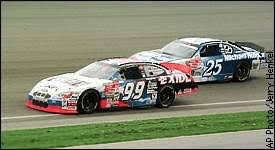
Opening the year up with the Daytona 500, Burton found himself in the lead group with the the checkered flag in sight, and after the Fords ditched Johnny Benson’s Pontiac, the manufacturer occupied the entire top-5.
Burton lined up right behind defending Cup champ Dale Jarrett for the final few laps. Playing out like a microcosm of the previous season, Jarrett’s strong #88 Quality Care Taurus held off the advances of Burton and surged ahead to win his third Daytona 500 while the #99 team settled for second.
Bad runs at Rockingham and later Atlanta were split up by a rain-shortened win in Las Vegas of all places, maintaining Roush’s dominance on the flat 1.5-miler since its 1998 debut.
Taking the lead on lap 64 in Atlanta, the Exide machine looked strong, but its dominance was painfully short-lived when the camera panned over to turn 3 with the leader riding driver’s side against the outside wall.
His last-place result plunged Burton into the thick of the top-15 in points, almost 200 points behind points leader Bobby Labonte after just four races.
The Roush Racing group collected themselves for the following month, scoring three top-5s in the next four races that included two runner-ups at Texas and Martinsville. The string of great finishes vaulted Jeff to the top-5 in points again behind Ward and leader Labonte.
Scott Pruett and Robby Gordon triggered the Big One at Talladega, cleaning out several contenders like Labonte while Burton escaped unscathed. Being handed points on a silver platter for the first time since Vegas, Burton and company were unable to capitalize, ending their day nine spots higher than Bobby in 12th.
Two more top-10s at Fontana and Richmond while Labonte faltered brought Jeff within 59 points of the coveted points lead with a third of the season in the books.
A painful reality for Stoddard and Burton set in after Richmond.
Bobby Labonte’s 26th-place run at Richmond would be his worst finish of the 2000 season.
The Joe Gibbs Racing veteran jumped ahead with a 2nd-place finish to Burton’s new teammate Matt Kenseth while the #99 claimed a pedestrian 11th and followed it up with a terrible 34th at Dover.
June was a mixed bag for the #99 team with just one top-10 and a few top-20 runs while Labonte extended the gap with three top-5s over the month.
And, as the series rolled into Daytona for a second time, the electrifying Exide Batteries team flipped a switch.
In a reversal of fortunes from the season opener, Burton assumed the lead on lap 121 and braved the challenges of Dale Jarrett to snag the first restrictor-plate race win of his career and his second win of the year.
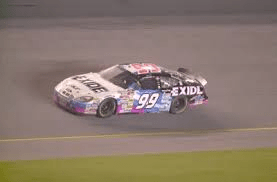
The win kicked off a titanic summer for Burton. The Virginia native scored one finish outside the top-10 from Daytona to the second Loudon race, and that one outlier was 11th place in a rain-shortened race at the first Loudon race, shrouded by the recent deaths of Adam Petty in May and Kenny Irwin Jr. that weekend.
Labonte kept pace with Burton over this stretch, notching two 15th-place results at Bristol and Richmond while earning victories at Indianapolis and Darlington, the latter of which Burton was on the #18’s bumper right up to the final green-flag lap when rain cut the race short for the second-straight year.
Approaching the second Loudon race, concerns swirled in the garage among drivers and teams about the speeds reached by these screaming metal monsters on New Hampshire’s straights. The deaths of both Petty and Irwin were attributed to both drivers experiencing a hung throttle heading into turn 3.
Instead of aiming for further safety measures, NASCAR did something different: they gave each team a restrictor plate to reduce speeds at the tight 1-mile oval.
It sounds insane today, but the device aided in efforts to slow cars down at big superspeedways like Daytona and Talladega and prevent scary crashes like Bobby Allison’s catchfence-ripping accident at Talladega in 1987.
Let me assuage any concerns you might have: no NASCAR driver since Kenny Irwin Jr. has perished as a result of injuries sustained in a race car at New Hampshire Motor Speedway.
What did happen, though, was NASCAR put on one of the worst races in modern era history.
Burton steadily clawed his way back to within a race of Labonte heading into the homestretch of the 2000 season, and to add even more tension to a stressful weekend at Loudon full of anxiety, the points leaders qualified together on the front row.
From the time the green flag fell, Jeff Burton fired off from the second starting spot and took the lead on the outside of Labonte in turn 1, and he never once looked back.
Much is made of Martin Truex Jr.’s performance in the 2016 Coca-Cola 600 where he led all but 8 of the race’s 400 laps on his way to winner’s circle, but Jeff Burton outdid that percentage.
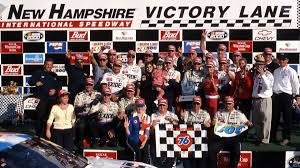
He led all 300 laps of the 2000 Dura Lube 300 at New Hampshire, the first driver to lead every lap and win since Cale Yarborough won at Nashville in 1978.
Interestingly enough, Christian Eckes matched the feat this year at Nashville SuperSpeedway in the Truck Series, but in the Cup Series, Truex is the only one to have gotten close to joining Burton.
The Battle of the Batteries ran out of juice there with Burton sitting 168 points behind Labonte with eight races left to run because the Exide car crashed out of the next race at Dover, ending the day 36th while the Interstate Batteries car completed every lap and racked up his 15th top-5 of the season.
Losing 100 points with so few races left on the schedule was a death sentence for the team’s title hopes.
Championship dreams weren’t the only things in tatters. Exide Batteries announced at the beginning of the year that they would be leaving the #99 team at season’s end, leaving team owner Jack Roush to scramble for another sponsor for his driver sitting second in points to Exide’s biggest competitor.
Citgo entered a three-year deal with Roush Racing to sponsor Burton, starting at the fall Charlotte race, and it didn’t take long for the South Boston man to make an appearance in victory lane with his new paint job.
Now fighting with the unparalleled Dale Earnhardt Sr. for second in points, Burton made Citgo happy by claiming the sponsor’s first points race win since 1991 at Phoenix.
Mark Martin stayed out under the final caution, anticipating that the older rubber would keep him up front long enough for the last 11 laps, and it worked…for a short while.
Burton’s blue Citgo Ford Taurus overtook the Martins’ Valvoline mobile on the outside of turn 3 and stretched out the gap for the final laps to earn his fourth and final win of 2000, breaking Citgo’s nine-year winless streak.
That win brought the Virginia vet within eight points of Earnhardt in second, but by that point, Labonte running the final two races was just a formality. Burton ended the year third in points after finishes of 11th and 12th at Homestead and Atlanta, respectively.
Only finishing outside the top-20 five times in 34 races, Burton’s strongest charge fizzled out against Labonte’s electrifying 2000 season where Burton’s impressive 10.2 average finish paled in comparison to Labonte’s 7.4.
In the next installment of Falling Short, I’ll be discussing Burton’s renaissance in the late-2000s at Richard Childress Racing and diagnosing what held him back from attaining the sport’s highest honor.
(Top Photo Credit: The Ledger)
 pitboxpress.com