
Those of you out there that gravitated towards the sport in recent years recognize Jeff Burton as a lead analyst in the NBC Sports booth, but in his day, Burton rubbed elbows with the greatest in the sport on the track.
Despite that, Burton ended his incredible Cup career without a Cup Series title, and today, we’re going to examine the seasons where Burton contended for the title to study any trends that may have developed over the years that led to Jeff’s trophy case having an omission.
Growing up in South Boston, Virginia, Jeff Burton and older brother Ward latched onto auto racing early in life, piloting go-karts and eventually climbing the racing ladder up to late models at nearby South Boston Speedway in the mid-1980s.
The Burtons cut their teeth at their local short track and built their reputation against the grizzled veterans while dipping their toes in the pools of the NASCAR Busch Series. The NASCAR moonlighting presented Jeff with an opportunity to race in the Busch Series with sponsorship from Armour Lower Salt Bacon.
Jeff remained in the Busch Series until 1994 when — after collecting four victories and achieving success with multiple teams — got his big break with the Stavola Brothers to drive the Raybestos #8 Ford Thunderbird.
Off the strength of two top-5s in underfunded equipment, Burton’s 24th-place points finish clinched his victory for Raybestos Rookie of the Year over a class including Ward.
His 1995 offered few positive returns with Burton failing to qualify for three races and missing out on the top-10 entirely until the Bristol night race in August. The fall Rockingham race allowed the young Virginian to show his mettle, cruising to a top-5 finish at one of NASCAR’s most challenging tracks.
A call from Jack Roush in 1995 gave Jeff the opportunity of a lifetime. The third-year driver moved on from Stavola Brothers in favor of a brand-new team with Roush Racing.
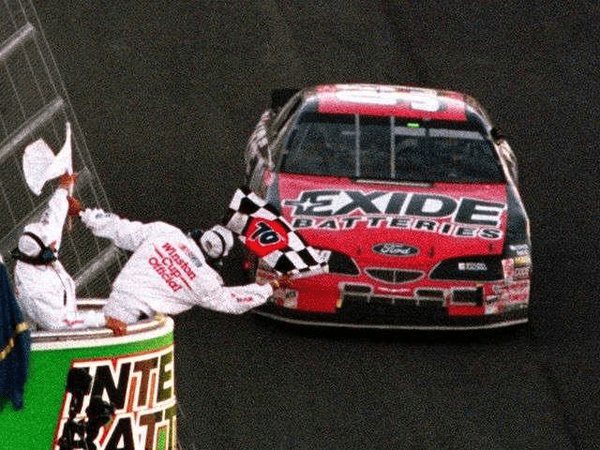
The mint #99 Exide Batteries Ford Thunderbird bolstered Burton’s blossoming talent, collecting three top-10s in the first five races broken up by a DNQ in Atlanta while sitting second in the points.
Burton’s bright-eyed Roush squad improved over the course of 1996, hovering in the top-20 in points for much of the year before a late turnaround hoisted the team to 13th in the final standings on the back of six top-5s and 12 top-10s.
As the 1997 season opened up in Daytona Beach, Jeff Burton looked to cement himself as a household name.
1997: A New Day
Now 29 years old, Burton faced a field of hungry Winston Cup drivers with bravery and humility, no doubt siphoning the “clean driving” from his more experienced teammate, Mark Martin.
Martin spent the better part of his Cup career at Roush Racing after an excursion trying to make it on his own in the early-80s, and the Arkansas native raised the Ford team to prominence in the 1990s, finishing sixth or better in points in every season for the decade.
Having Martin as a resource was invaluable to the upstart Burton, and it was Martin’s experience and expertise that the #99 team began to implement and parlay more into results in the second half of the previous year.
Over the season’s first five races, Burton stacked three top-5s to vault himself up to fifth in the standings before taking the series’ first trip to the newly-built Texas Motor Speedway. A contest of attrition ensued with crashes involving 23 different drivers over the race’s 334 laps.
Race leader Todd Bodine (filling in for the concussed Ricky Craven) found the turn 2 wall with less than 60 laps to go after contact with Lake Speed, handing Burton a lead he would not relinquish.
Jeff paced the field for the final 58 laps en route to his first career Winston Cup victory, matching his brother’s accomplishment from two years before when Ward scored the victory at the fall Rockingham race.
All the positive momentum and points gained from getting the proverbial monkey off his back at Texas was washed away by a puddle of oily fluid as a blown engine gave Burton his second 42nd-place finish.
Major issues evaded the Exide Batteries bunch for the next two months as the purple powerhouse made regular appearances in the top-10 with three straight top-5s at Charlotte, Dover, and Pocono.
By the halfway point of the season, Burton sat fifth in points, tied with Dale Earnhardt at 287 points behind Jeff Gordon with defending champion Terry Labonte, Mark Martin, and Dale Jarrett occupying the other spots in the top-5.
The very next race at New Hampshire put Burton in the mix for the win with the Yates cars of Jarrett and Ernie Irvan, but ultimately, the #99 Thunderbird stormed to the lead on a pit stop under the second and final yellow on lap 196.
The young Virginia upstart went toe-to-toe with seven-time Winston Cup champion Earnhardt over the race’s final run before both drivers dove onto pit road for a splash of fuel on lap 285.
With Earnhardt nearly seven seconds behind Burton, the #99’s quick stop nearly ended in disaster as Earnhardt headed to his stall for service, putting the two leaders in supremely close quarters on pit road.
Both escaped unscathed, but only one could win as Burton scored his second career Cup victory in Loudon as his championship rivals Gordon and Jarrett struggled to post good results. The win put Burton under 200 points behind new points leader Texas Terry, the closest he’d get to the points lead over the rest of the season.

It wasn’t that Burton was bad either. The 1997 points race is one of the most compelling (albeit underrated) seasons in NASCAR history, and Martin, Jarrett, and Gordon throttled their less experienced competition.
Mishaps and speed deficits to the top-3 marred the Exide Batteries team from truly competing for their first title as sub-25th-place finishes at Watkins Glen, Rockingham, and the Atlanta finale detracted from an otherwise amazing stretch where Burton landed eight top-10s in the season’s second half.
Burton’s brimming talent shined through some light controversy in his home state. Keeping the Exide Ford up front for a majority of the race, the South Boston native took advantage of a Rusty Wallace penalty on the final restart to nab his third and final victory of 1997 at Martinsville Speedway.
The season’s final four races weren’t especially kind to Burton, but he managed to hold his career-best fourth-place points finish, 425 points behind eventual champion Gordon while Martin and Jarrett fell just 29 and 14 points short of their first Winston Cup.
All told, Burton collected three wins, 13 top-5s, and 18 top-10s over the schedule’s 32 events. However, a new challenge awaited Burton and the rest of the Ford fleet for 1998: the new Ford Taurus.
I could go into depth about how the 1998 Ford Taurus is far different from the road car that bears the same name, but multiple folks on YouTube have covered this at-length with engineering lingo that’s frankly outside of my own personal vocabulary.
In short, the 1998 Taurus gave the Ford teams a big leg up aerodynamically, making Roush’s now five-car lineup featuring Burton, Martin, Ted Musgrave, Chad Little, and Johnny Benson as fearsome as ever.
1998: Failure to Launch

With Penske Racing South piloting the development of the new Taurus, the other Ford teams found issues with the new model, especially on the superspeedways where the car’s enhanced drag made it a curveball for engineers that spent years mastering the Thunderbird.
Burton’s crew chief Frank Stoddard didn’t master the new Ford body right away, but the team still stuck their necks out for a dominant run at Darlington that ended in a disappointing fifth-place result.
Early-season visits to the restrictor plate tracks ended with blown engines, logging just 51 laps at Talladega that plummeted the #99 car to 16th in points. What appeared to be the team’s darkest hour after three straight races of finishing worse than 29th was actually just the precursor to an amazing final 24 races.
Stoddard and Burton tuned their new Tauruses better and better for the next six weeks, never slipping out of the top-10 in that time and climbing their way back to eighth in points. Handling issues at Sonoma couldn’t slow the Roush Racing gravy train heading into Loudon.
Behind the wheel of a masterful piece, Burton rose from the fifth starting spot and traded the lead in the first 100 laps with defending champ Gordon. Burton took command of the race right before the halfway mark and cruised to an easy victory, defeating Martin by over seven seconds to claim the #99 team’s first win of 1998.
Troubles at Indy and Watkins Glen in August all but eliminated Burton from championship contention because Gordon and Martin separated themselves from the rest of the field.
Five-straight top-5s from the second Michigan date to the September Richmond race culminated in the Virginia native scoring a dominant victory at one of his hometown tracks. Already several laps off the pace the following week at Dover, Burton brought out the race’s fifth caution by wrecking on the frontstretch.

The 38th-place effort shuffled Burton down to seventh in points, but strong runs at the final trio of races propelled the 31-year-old to a fifth-place points finish for 1998, 913 points behind champion Jeff Gordon.
Remember how I said 1997 was one of NASCAR’s most compelling title battles? 1998 was owned by Jeff Gordon and Mark Martin, winning at 20 stops on the 33-race tour and leaving their competition in the dust.
Gordon, in particular, flexed his muscle as his 1998 Chevy Monte Carlo scored 13 victories, 10 of them coming in the season’s final 20 races. The Rainbow Warriors were destined for greatness, clinching a third Winston Cup with a 374-point lead over Martin in second.
In fact, Burton finished fifth in the final standings and the last driver to be within 1000 points of Gordon at the conclusion of 1998. Bobby Hamilton clung to the last top-10 points position, and Gordon outscored him by a staggering 1542 points.
This gap would have required Hamilton to score maximum points (then 185 points) while Gordon sat at home out of the car for over a quarter of the season.
Gordon’s 1998 was otherworldly. The closest we’ve come to that performance since is Kevin Harvick’s 2020 performance and Kyle Larson’s 2021 championship season. With the advent of the NextGen car, we will likely never see a yearlong beatdown of such epic proportions ever again.
In the next installment of Falling Short, I’ll be discussing Burton’s rise to title threat in 1999-2000 and what — if anything — Jeff could’ve done to change his fate.
(Top Photo Credit: NASCAR’s Facebook page)
 pitboxpress.com