
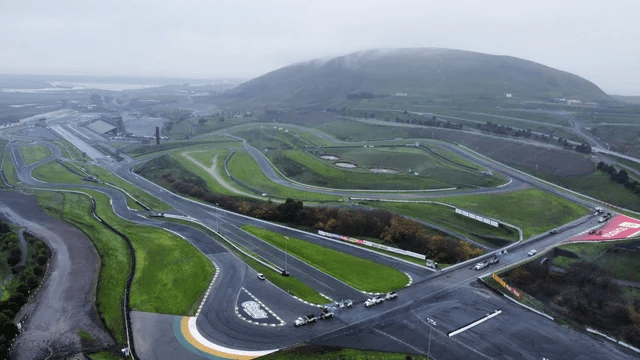
Laying in the shadows of Sears Point sits a twisted race track with a real mean streak: Sonoma Raceway.
The stars of the NASCAR Cup Series swing right and left this weekend for the 35th running of the Toyota/Save Mart 350(k), the 16th stop on the series’ nationwide tour.
An exciting race emerged in St. Louis last Sunday when pole sitter Michael McDowell led the field to green and held the top spot for most of the first stage until Christopher Bell scooted by the Front Row Motorsports driver to snag a stage victory for his #20 team.
Joe Gibbs Racing’s ascending talent manhandled the competition for much of the first two stages before a strategy call toward the end of stage 2 gave all three Penske Fords the lead for the final stage.
That second stage was not without controversy.
Kyle Larson and Kyle Busch attracted each other like magnets as the laps withered away in the second stage. Busch needs every last point that he can get; Larson hustles his car to make up for lost time last week.
Coming to the final lap of the stage, Larson rose from the bottom out of turn 4 and clipped Busch’s left rear wheel well, incensing the elder Kyle. Busch scrubbed against Larson’s right side down the straight to express his displeasure before pinching the #5 car going into the narrow and tight turn 1.
Larson’s HendrickCars Camaro broke traction, slid into Busch, and after both cars were likely to end stage 2 with a chance to get a good result, they both chose to instead ruin their days and their race cars.
The crash proved to be the final caution of the day as the final 92 laps were focused in on watching Bell patiently dissecting the cars ahead of him until fourth-place Carson Hocevar kicked off the final pit cycle.
Pitting with nearly 60 laps to go around Gateway’s 1.25-mile track, Ryan Blaney needed enough fuel for the final 75 miles to claim the first win of his title defense.
But first, he needed to face off with Christopher Bell.
Bell took to the pit lane for service a few laps later, setting his sights on the #12 Richmond Water Heaters Menards Ford. Bell’s slight tire advantage made it look like a foregone conclusion that his #20 car would find victory lane two weeks in a row, but as he caught the dayglo Mustang, Blaney went on the defense.
Climbing up to the highest groove on the track (and at times over it), Blaney successfully defended Bell’s advances for a dozen laps by using the superior momentum generated from the higher groove.
As the race entered the last 20 laps, Bell’s DeWalt Camry surged by a struggling Blaney off of turn 4, leading a lap before the crafty champion ducked underneath and took the spot back in turns 1 & 2.
Blaney employed an aero-block on Bell entering turn 3. What initially looked like Bell’s Toyota rudely reacting to its line being taken away shifted to a terminal issue in the flash of a firework.
The Toyota TRD engine failed while fighting for the win. Thanks to the heroics of his lapped teammate Martin Truex Jr. (the victim of a stage 2 tire failure), Bell held on for a top-10, finishing 7th in front of Carson Hocevar, the first driver of the pit cycle.
Penske seemed set for a 1-2 finish, yet as the laps reached the low single digits, the interval from Blaney to Cindric in second started to flake off, no doubt due to how lapped traffic raced the leader.
Exiting turn 4, the #12 gasped for air and gasoline and came up empty, the fuel tank drying up with the white flag in the starter’s hand. Cindric’s Freightliner #2 slipped by right before the finish line and experienced no fuel issues on the way to his second career Cup Series victory.
The 25-year-old became the first driver to punch his Playoff ticket at Team Penske this season while Blaney huffed and puffed his way to the finish line 24th, the last car on the lead lap. Even Daniel Suárez, who he was battling on the previous lap to put the #99 a lap down, beat Blaney to the line.
Cindric’s performance broke an 85-race winless streak dating back to the 2022 Daytona 500 and puts a wet blanket on fiery rumors within the industry claiming that the third-year man out of Ohio was on the hot seat.
A slew of drivers logged impressive results: rookie Hocevar came home a career-best 8th, his second top-10 of the year; Rick Ware Racing’s Justin Haley furthers his growth with another top-10 on an oval; Austin Dillon put his bad season behind him for an afternoon after finishing 6th; and, Larson rebounded to end the day 10th.
Denny Hamlin assumed the point lead following a stellar (albeit unexpected) runner-up finish, piling up 21 points more than second-place driver Kyle Larson.
The most-publicized debate in NASCAR ended on Tuesday when the sanctioning body approved Kyle Larson’s waiver application for missing the Coca-Cola 600 with senior vice president of competition, Elton Sawyer, giving the sport’s explanation for the approval.
Stewart-Haas Racing looks to ship off one each of their three charters to the following teams: Trackhouse, 23XI, and Front Row Motorsports. The fourth charter remains a mystery as Bob Pockrass of Fox Sports reporting that Legacy Motor Club, RFK Racing, and JTG Daugherty Racing are in the expansion market.
I look forward to updating this story as it continues to develop, but let’s move onto Sonoma.
Constructed by Robert Marshall Jr. and Jim Coleman in 1968, the circuit hosted events for SCCA, IndyCar, IMSA, Can Am, Trans-Am, and MotoAmerica before reigning in the NASCAR Winston Cup Series for its inaugural stop in the Napa Valley in 1989.

Originally run as a combination race with the Winston West Series, Winstop Cup veteran Ricky Rudd motored away from the pack in his #26 Quaker State Buick Regal, leading 61 of the race’s 74 laps en route to his lone win of the season.
Time wore on and a couple of young guys hit the scene and started pulverizing everyone on these road courses; they went by the names of Jeff Gordon and Tony Stewart.
Both drivers forged their path to NASCAR’s top division through the annals of open-wheel racing, a style of driving that melded perfectly with the concept of a road course.
The results were glowing with Stewart scoring three wins (including his last) while Gordon wears the crown as the King of the Mountain after conquering the circuit a record five times.
Drivers surge toward the start-finish line where cars shoot uphill after a quick left-hander. Wrangling the car up the steep embankment is no easy feat as the fine line before determination and disaster gets played with like jump rope as the road cranks back to the right towards the hill’s summit.
Cars dive down the hill and pull over to the right, setting the load of their cars to carry speed back uphill after the quick left of 3a into the right-hander of 3b.
Towering over the rest of the track, turn 3b sits 160ft higher than the lowest portion of the speedway, the largest elevation change of any track in NASCAR.
Instead of sneaking into the infield and careening towards the carousel, cars fling themselves down the slopes into the ever-treacherous turn 4a. The low-grip right throws off the rhythm of even the most talented drivers, disrupting their momentum down the short chute for the right-hand hairpin of turn 7a.
The site of multiple collisions, the hard braking zone into this turn makes gullible drivers think they’ll have the grip necessary to make the lunge of the century, but more often than not, they end up into the dried grass that lines the course in the summer time.
The road descends from here through the Esses, a series of undulating rights-and-lefts that empty out into another low-grip right in turn 10 where a multitude of drivers have made friends with the tire barrier.
Drivers enter the final stretch that ends in the track’s second prominent passing zone, the turn 11 hairpin.
Home to the lowest point on the whole track at 14ft above sea level, the hairpin’s new inside wall is sure to bar drivers from shortcutting the course, subsequently forcing them to ride the rumble strip until exiting the turn.
The track opens up to a small straight before canting to the left of turn 12 to cross the finish line and complete the lap. All told, Sonoma Raceway current layout measures out to 1.99 miles.
With our knowledge of the track and its many obstacles, let’s head on over to the weather and fast facts.
The Weather & Fast Facts
Sonoma remains a stranger to rain this weekend as we set up for another sunny Sunday afternoon in northern California with a projected high of 78°F, a shade lower than the 10-year average.
The Toyota/Save Mart 350(k) represents the last stop on the Cup Series calendar for FOX Sports as NBC will take over broadcasts of NASCAR’s premier series from Iowa until the Phoenix finale.
Going green at 3:30pm Eastern time on FOX, NASCAR splits the 110-lap race into three stages, ending on laps 25-55-110 unless there’s Overtime, which is a rare occurrence at Sears Point. The 2021 race suffered eight yellows and became the first race to extend the race distance, resulting in a Kyle Larson victory.
Oftentimes, the racing at Sonoma is highly technical. This means drivers setup a pass on another driver for several turns, even several laps, so some of the most patient drivers in the series experience the most success.
Sonoma is unlike other road courses in that the track crew takes care of cautions in a timely manner, averaging 4 cautions per race over the last 10 years that slowed the field for just 13 laps.
Passing comes at a premium when swooping around this circuit, so to give their drivers an advantage, crew chiefs will have their drivers pit at a certain time in hopes of moving closer to the front. Logging over 2600 passes on average every race weekend, much of these overtakes occur because of strategy variance.
Another natural consequence of strategic racing is lead changes. Though not known for the most dynamic racing product, the track still averages a lead change every 11 laps at Sonoma, pushing new players to the front throughout the race all the way until the checkered flag.
Despite the shortened amount of laps compared to most tracks, a typical Sonoma race lasts close to 2 hours and 49 minutes, so if you have somewhere to be, make sure you make arrangements after 6:30pm ET.
Moving on now to the betting lines, let’s see what the oddsmakers have to say about this weekend’s race.
The Odds

Keeping consistent with the new method of going about the odds, our first selection to discuss is Hendrick Motorsports driver William Byron (+1100).
The 2024 Daytona 500 champion struggled mightily in St. Louis last week and looks to get back to victory lane for the first time since Martinsville in April. Sonoma might not be the venue for a turnaround as the 26-year-old scored just one top-10 in his five starts at the track, holding a dismal 20.4 average finish.
Next up is 2021 Sonoma winner Kyle Larson (+400). The Indianapolis 500 rookie of the year scraped and clawed his way back to a top-10 result at Gateway last week, moving him past Byron for second in points.
Hendrick Motorsports rolls into every road course race with a great chance to win because they unload with speed; I don’t foresee that changing this weekend. 2021’s strategy call no longer works, so crew chief Cliff Daniels must cook up a better pit sequence than the last two seasons to sip wine in victory lane yet again.
Confusingly, Tyler Reddick (+600) holds the third spot among eligible Playoff drivers. Michael Jordan’s prizefighter enters the weekend without a single top-15 in Sonoma despite his prowess on other circuits that swing both right and left.
The fifth-year driver out of nearby Corning, CA suffered from mechanical issues at each NextGen race, losing great runs to aspects out of his control. A year wiser and stronger, perhaps Reddick will have the reliability of his equipment match up with his talent, leading to a feel-good hometown win.
As for the two drivers not currently in the Playoffs, I’m intrigued most by Chris Buescher (+1400) and Will Brown (+2800). Buescher inches his way closer and closer to the cutline every week after losing by centimeters at Kansas last month.
Buescher’s passionate fan base feels Buescher’s turn 4a tire lock-up spoiled a potential 2022 triumph, and after collecting a second-consecutive top-5 in last year’s race, look for the #17 Ford Mustang to show out early and often on Sunday.
A relative unknown stateside, the Queensland native contends for the V8 Supercars title in Australia where he currently leads the points. Like Shane van Gisbergen and Brodie Kostecki before him, Brown presents a real threat to the Cup Series faithful, and he’ll attempt to reward himself with a belated birthday present on Sunday.
Writer’s Pick
I picked Ryan Blaney last week, and at the start of lap 239, I was looking forward to selecting the winner for the third time this season. Then, he ran out of gas and finished 24th.
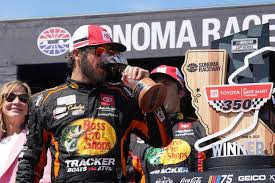
Ah well, nevertheless! My pick this week should be the consensus choice: Martin Truex Jr (+1200).
The New Jerseyan steps into northern California for the 18th time in search of a 5th win at Sonoma, tying a record set previously by Jeff Gordon. Truex earned his second career victory here in 2013, and since then, he’s been supremely impressive, leading a series-high 264 laps and racking up five more top-5s in the last 10 races.
That said, don’t count out Daniel Suárez. His 2022 win at the track shows he’s capable of claiming a win here if Truex doesn’t rise through the field on his way to the wine glass.
 pitboxpress.com