
The stars of the NASCAR Cup Series scream into Fort Worth for the series’ 43rd visit to Texas Motor Speedway. The track plays host to the 9th stop on the 2024 Cup Series’ 36-race coast-to-coast tour.
The eighth stop of the season saw a Hendrick house party in Virginia as all four Hendrick cars dazzled with ruby red schemes for the team’s 40th anniversary of their inaugural win with Geoff Bodine.
A grueling day with minimal passing opportunities escalated an already-growing issue with NASCAR’s short-track package with last Sunday’s race essentially being clinched on pit road by William Byron’s pit crew with nearly 100 laps to go.
The drama of the weekend was not intent on making this easy for Rick Hendrick as a late-caution waved for John Hunter Nemechek losing a brake rotor entering turn 1 with two laps remaining.
Byron opted not to pit, controlled the final restart, and held off his hungry Hendrick teammates, driving into the sunset for his stunning third win of the young 2024 campaign.
In spite of the fanfare, the racing product made its way back under the microscope yet again.
Three of the last four weekends took place on short tracks, featuring 1300 laps of confounding racing where it proved difficult for drivers to get an advantage on one another.
Drivers rode close together, and their lap times confirmed a worrying trend.
NASCAR pursued the construction and implementation of the NextGen car in hopes to decrease costs and labor to save teams money. In the process, the cars themselves have shown their prowess on the intermediate tracks while producing a less-than-desirable product on short tracks and most road courses.
This resulted from all of the aerodynamic components put on the cars to help them turn and create turbulence behind them that disrupts drivers in their wake, most notoriously the diffuser.
Though ride heights have presented some issues as well, the main culprit in all of this is the wider tire now featured on the NextGen car. Cars have more grip because more of the tires’ rubber is able to stick to the racing surface.
And, if drivers have more grip, they will inevitably make the cars faster and handle turns with more efficiency. This is usually met with drivers being able to improve, but with every car in the field running the same speed, it’s hard to tell what’s skill and what are the weaknesses of the car itself.
Back to the track, Texas Motor Speedway makes its way back to the spring for 2024 following a slew of fall races and a pair of All-Star events in recent years.
Located in Ft. Worth, Texas, the 1.5-mile oval has endured its fair share of redesigns and criticism since opening its gates in the spring of 1997 with Jeff Burton scoring the inaugural Cup Series win.
The 7-time Cup champion Jimmie Johnson, who rolls off 37th on Sunday, holds the all-time Cup wins record at TMS with a fitting seven victories at the circuit, his most-recent win coming in 2017.

The front stretch is constructed in a quad-oval fashion with 5 degrees of banking with the start-finish line sitting dead center in between the two doglegs.
Cranking a left after crossing the line, drivers set their sights on turn 1, which you’ll undoubtedly hear is rather treacherous this weekend.
A 2017 repave project commissioned by track owners Speedway Motorsports Inc. led to a reconfiguration of turns 1 & 2 from their initial 24° down to 20°. The changes also widened the racing surface from an already-wide 60 feet up to an unconscionable 80 feet.
For reference, the average Cup car is 6.75-feet long, meaning that cars could spread out as far as 12-wide going through the tracks first two turns.
Due to some track ownership decisions, the 2019 races at Texas were plagued by the application of the PJ1 traction compound in the upper grooves of the race track.
This was done in an attempt to spread the racing line out for the drivers and teams across several racing disciplines, but it has made the track even more difficult to race on as the racing line stays below the PJ1.
Track workers have worked for years to wear out the traction compound. Their efforts have been in vain, leaving the top three grooves of the first two turns still stained with the stuff.
Thus, navigating turns 1 & 2 is a delicate balance for drivers as they attempt to keep their cars going left. One slip up into the PJ1 can end a day very quickly for unsuspecting drivers.

The exit of turn 2 presents its own challenge as the track narrows up from a width of 80 feet to 58 feet, funneling the cars towards the outside wall.
A jaunt down the backstretch empties into the entry of turn 3 that remains 24° and 60 feet wide from Texas’ 1997 layout where most drivers are able to mash the throttle to the floor while their tires are fresh.
Drivers will stay wound up through turn 4 until landing on the front stretch yet again, rolling through the course’s final dogleg, and crossing the start-finish line.
Now that we’ve gotten acquainted with the race track, let’s take a look at this weekend’s forecast.
The Weather & Fast Facts

Every week, I take the historical weather data over the past decade to give you the most-accurate expectations you should have for race day if you’re heading to the race track.
In that time period, the track saw rain just twice on the second Sunday of April in Ft. Worth, both ending before 2pm. Thankfully, this Sunday won’t see moisture of any kind with a 1% chance of precipitation.
Sunday will be a heater with a high of 84°F, 8° higher than average. The low of 66°F will slip into view as the race is coming to an end, so don’t look for the temperatures on the track and in the air to change much during the race.
A hot race track provides better racing oftentimes because a warmer track surface is harder on the tire rubber and the car overall throughout the day.
Keep your eyes peeled for mistakes as Texas’ last seven spring races (as well as the last three fall races) have maintained a surprisingly high 9-caution average that slows the field for 48 laps.
Though not normally heralded for its racing product, Texas Motor Speedway holds averages of 22 lead changes and 2562 green-flag passes, a stark departure from the past month’s short-track swing.
The green flag is set to drop at 3:32pm Eastern Time (2:32pm local) on FS1, and the 10 races sampled show that races tend to last over three-and-a-half hours.
However, it is important to note that last fall’s race was the first 400-mile race at Texas, lasting almost 3 hours and 15 minutes. That race endured an above-average amount of cautions, so I’d expect this race to end closer to three hours after the green flag drops.
The 10 sampled races over the past decade featured a final caution lap average of lap 240, close to 27 laps to go. Over that same span, only one race (2014 spring) saw the field head into NASCAR Overtime.
With the weather and fast facts shared, let’s take a look at whom the oddsmakers favor to win the Autotrader EchoPark Automotive 400.
The Odds
Last week, the folks at BetMGM placed pole sitter Kyle Larson at the top of their odds, but it was actually his teammate William Byron (+1300) that notched his third win of the season at Martinsville.
This week shows that while some things may change, others stay the same.
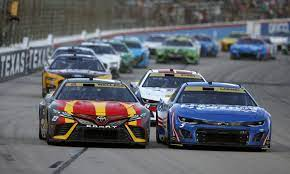
Larson (+350) topped the charts for his third pole of the season Saturday afternoon in his fast #5 Chevy Camaro. After a celebration of Hendrick Motorsports’ 40 years of excellence last week, Larson further cemented the team’s spot in the sport’s history by claiming HMS’ 250th pole position.
The 31-year-old has found success in Ft. Worth before, sweeping the 2021 events at the track (the All-Star Race and the fall points race) and looked poised for another victory last fall before a late race caution flew.
This brought the field closer together for the final laps, resulting in Larson fighting hard to keep the lead from Bubba Wallace. Larson’s car slid out from under him and backed into the fence, ending his chances, but with another great Chevy underneath him today, expect the 2021 champ to contend for the win.
Speaking of William Byron (+700), the driver of the #24 lines up five spots behind his Hendrick teammate in the sixth spot. Byron’s 2024 started hot with a win in the Daytona 500, and subsequent wins at COTA and Martinsville last week dumped gas on the fire, extinguishing his detractors.
Byron wheeled his Axalta Camaro from the 18th starting spot to snatch the lead during green-flag pit stops in stage three. Despite an Overtime restart, the North Carolina native clung to the lead for the final two laps to score his 13th career Cup Series victory.
Byron’s team should feel no pressure the rest of the regular season now that a Playoff spot is secured, but that won’t stop them from running up at the front. I don’t predict that’ll change come Sunday afternoon.
Gunning for the Hendrick drivers is Denny Hamlin (+825). The short-track ace failed to complete the short-track sweep last weekend after a slow final green-flag stop sunk him into the pack.
The race got away from the #11 team, but sporting the Yahoo! colors this weekend, Hamlin searches for his first win on an intermediate since Kansas last spring. The veteran is no stranger to Texas Motor Speedway victory lane, having visited three times with the most recent coming in spring 2019.
Hamlin’s patience behind the wheel exemplifies why he is such a great driver. Looking to land his third victory of 2024, Hamlin’s #11 Yahoo! Toyota Camry rolls off in P11 smelling blood in the water at the top of the point standings.
Hamlin’s stablemate at Joe Gibbs Racing is Christopher Bell (+600). The Oklahoman pulls into Texas in what is perhaps his closest track to his hometown of Norman, making this a homecoming of sorts.
The pilot of the #20 Toyota Camry spent much of last Sunday off the lead lap. After a poor qualifying effort left him deep in the field, Bell just never quite got the handle on his race car, even causing a caution at the beginning of the final stage.
The 35th-place result dropped the Sooner five spots down in the points to 11th; with a lightning-fast Rheem Toyota, the 3rd starting spot inspires hope for Bell’s chances at snagging that elusive second win of 2024.
Rounding out the top-5 is none other than Martin Truex Jr. (+825). The cagy veteran dominated the day in Richmond without winning and failed to compete in Martinsville last weekend, finishing 18th one lap down.
The 2017 Cup champion takes a crack at Texas Motor Speedway for the 35th time still seeking his first victory at the track. Given the relative pace the JGR cars have had this season, it’s safe to say their 9th starting position shows the team has a strong piece for Sunday.
Truex knocked a win off at a long-sought-after venue in New Hampshire last season. In order for Truex to start chasing the regular season title in earnest, the #19 team can knock down another key win today in Texas.
Other notable lines include: RFK drivers Brad Keselowski (+4000) and Chris Buescher (+4000); Trackhouse Racing’s Daniel Suarez (+6000) and Ross Chastain (+1800); 23XI driver and last year’s pole sitter Bubba Wallace (+1400); and Team Penske Joey Logano (+2500), Ryan Blaney (+1300), and Austin Cindric (+15000).
Writer’s Pick
My writer’s pick for last week was Chase Elliott. After leading portions of the race, Elliott took a peek at the lead on the race’s final restart and settling for a stellar 3rd-place finish.
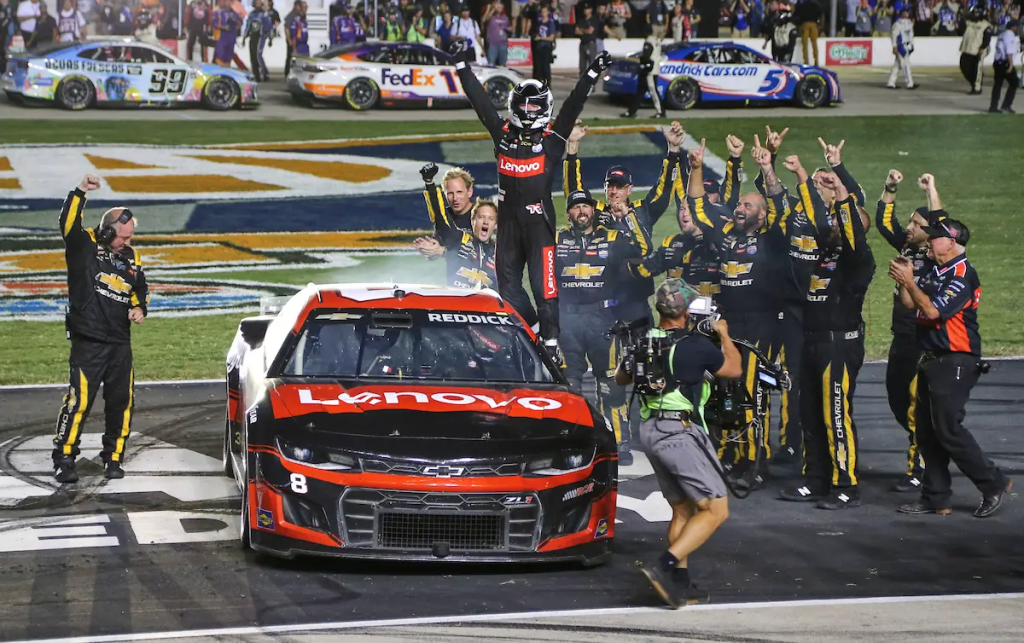
This week’s pick rolls off 4th this Sunday in The Beast Unleashed Toyota Camry, 23XI’s Tyler Reddick (+450).
Sporting the #45, Reddick nearly notched his first career win at this track in his rookie season, finishing an agonizing 2nd to then-teammate Austin Dillon.
Luckily for the Californian, he managed to brave the tire wear issues in the Texas fall race to grab his first ever oval win in the Cup Series.
Reddick’s sound driving style suits a track like Texas, and his track record here is nothing to scoff at by any stretch. As long as the #45 team keeps up with the track, Reddick is poised to avenge his Vegas defeat to Larson by adding another trophy from the Lone Star State.
(Top Photo Credit: Jonathan Bachmann/Getty Images)
 pitboxpress.com