
Ending races under yellow-flag conditions remains an issue in NASCAR 29 years after the implementation of the original Green-White-Checkered rule in the Craftsman Truck Series.
The Green-White-Checkered (GWC) rule (now known as NASCAR Overtime) is intended to promote a green-flag finish to a race that otherwise would have completed the scheduled distance of a race under caution.
In essence, the initial version of this rule allowed for unlimited GWC attempts, but after the rule was incorporated by the Cup Series in mid-2004, the sanctioning body decided to trim the number of attempts down to one.
This made the rule clean and rather streamlined: if a caution occurs before the final lap of the scheduled distance, one attempt will be made to end the race under the green flag by adding two additional green-flag laps. If a caution occurs during the GWC period, the race is over if the field has yet to reach the checkered flag.
NASCAR held this rule steady through the 2009 season before adjusting the rule to three GWC attempts before ending the race for 2010 onward.
The rule changed to allow for more attempts to finish the race under green. If a caution occurs on the first lap of a GWC attempt before the leader begins the final lap, NASCAR can line the field back up for at least two more attempts. On the third attempt, the race is over if a caution is thrown at all on the third attempt.
This rule change garnered controversy for extending the races too much, so NASCAR tried to solve this as well by adding the Overtime Line at the beginning of the 2016 season.
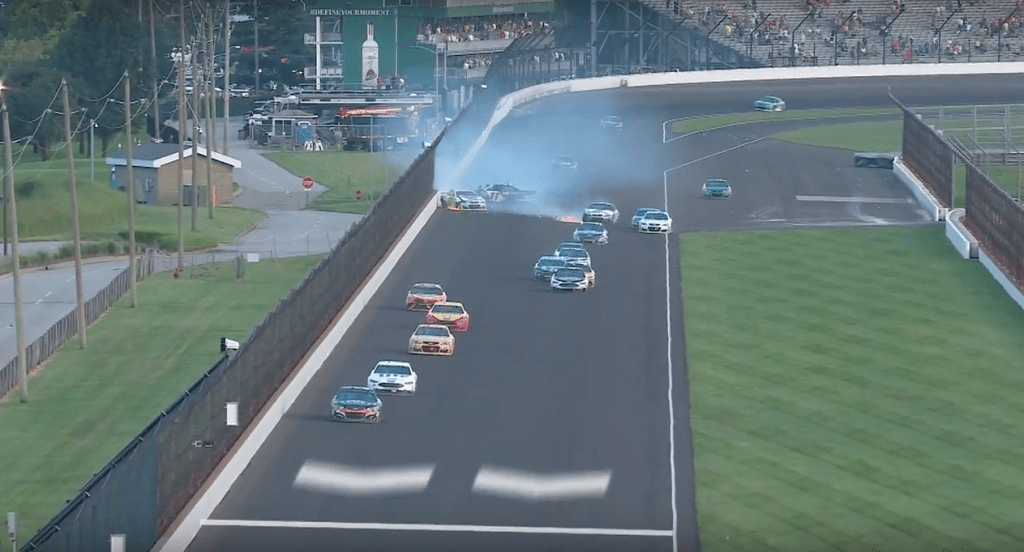
Instead of making it back to the white flag to certify a finish, the race will be over once the leader reaches the Overtime Line on the first lap of an Overtime attempt if a caution is to occur. This line could typically be found halfway down the back stretch at most oval tracks.
A slight alteration they snuck into the Overtime Line ruling was reverting the number of Overtime attempts back to an infinite amount.
The Overtime Line was widely maligned as officials would wait until the leader hit the Overtime Line to throw a caution, even though the cause of the caution happened well before the leader reached the line.
After a year-and-a-half of this rule, NASCAR abandoned the Overtime Line concept, instead opting to revive the original rule from the Truck Series: unlimited attempts until the field reaches the final lap.
This decision has led to multiple controversial finishes since the Overtime Line was removed, mostly centering on NASCAR’s shameless attempts to end a race under green that the drivers simply refuse to finish.
Some notable examples include: the 2023 Cup race at Circuit of the Americas (COTA), the 2023 Truck Series finale at Phoenix, and the 2023 Daytona 500.
The 2023 Cup race at COTA displayed just how lawless the sport allows itself to be and how quickly the leadership of this sport throws its hands in the air, acting like they have no influence.
A caution for a stalled Brad Keselowski with 12 laps to go led to a triple-overtime demolition derby that saw drivers as far back as 23rd using their extra sturdy NextGen cars to plow through the car ahead and use them as brakes into the tight turn 1.
This caused a massive accordion effect that resulted in the leader of the bottom line being unwittingly spun out by a car six rows (or more) behind him.
On the third Overtime restart, the carnage continued, but NASCAR didn’t throw a caution to allow for more restarts, which was a good decision. Why give them more opportunities to wreck?
The 2023 Truck Series finale was a farce on every possible level, but that’s a story for another day. For a race that was scheduled to be completed after 150 laps, the race kept getting extended because the field just could not possibly complete a single green-flag lap.
A 150-lap race ended after 179 laps, but it felt like 200. Still somehow just three attempts.
I was at this race. I expected to leave close to 8:30pm local time, but I didn’t leave the race track until after 10pm. Do you have any idea how annoying and taxing that is as a race fan? Why are the drivers given more opportunities to wreck each other and keep triggering more Overtimes?
Worst of all is last year’s Daytona 500, which should have been rebranded to the Daytona 530 after Ricky Stenhouse Jr. completed his 212th lap under caution to score the victory.
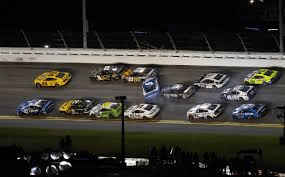
After a single-car wreck on the front stretch on lap 199 of 200, the field proceeded to have two pileups, collecting nine+ cars in each. Luckily, the field was able to make it to the white flag before the second pileup, but wasn’t the point of this rule supposed to be to finish under green?
That brings me to my ultimate proposal to fix this rule.
I do not like Overtime or really any stick-and-ball sports element brought to motorsports. However, I would allow for one (1) Overtime restart if it’s necessary to have them.
We should be able to trust this field of professionals to complete a single lap of green-flag racing without wrecking each other. They shouldn’t need a third, a fourth, or a fifth chance to prove they can complete a single green-flag lap without crashing.
Frankly, if you can’t complete one green-flag lap, you don’t deserve to finish the race under green.
Sure, this might be inconvenient for the fans, but at least two drivers had to get shoulder surgery in the offseason because of how hard their impacts are, especially at high speeds.
I feel like we should try to prevent accidents as much as possible to reduce the risk of injury. In fact, that’s why shoulders are being ripped apart: the foam padding that was reinforced to decrease the risk of concussions and other head injuries is negatively impacting drivers’ shoulders.
I could go on all day about how this is classic NASCAR, creating a problem while trying to solve a different one, but I won’t.
Here’s where my path diverges from every solution we’ve had prior to this season.
The Overtime Line was implemented in the worst way possible; it wasn’t a bad idea, though.
NASCAR has a varying amount of electronic timing-and-scoring loops around each racetrack, so in the case of a caution, NASCAR can see where drivers hit the most recent scoring loop prior to the time of caution to determine positioning for the following restart or end of the race.
The fans at home do not know where those lines are. We are never given that information. There aren’t lines painted on the track to denote where these lines are.
Let’s take out the ambiguity of it all and use some extra paint, and we can paint those timing lines around the racetrack. That way, those of us watching can clearly see who was ahead at the time of caution instead of having to piece together video footage to see if NASCAR is truthful.
The fans should be able to trust NASCAR, but with this current system, I don’t see how anyone can, considering they let the biggest event of the year lose an Overtime attempt and botched the run to the finish because they didn’t know when to throw a caution.
With all due possible respect, a car breaking loose and sliding into the trioval at any racetrack should be an automatic caution, especially when it happens at the front of the field. The risk of a car coming back up into full-speed traffic is way too high. Injury is increasingly possible.
NASCAR’s own reasoning for ending this year’s Daytona 500 was due to a blown judgment call on behalf of race direction.
Mike Forde, managing director of racing communications for NASCAR, came to Twitter to tell the world why they waited to throw a caution with two cars sliding into the infield of the trioval.
He thought that Cindric’s car wouldn’t shoot back up to the racing surface, so he waited to throw a caution for when it finally did re-emerge on the track.
This tells me that cautions are completely and wholly arbitrary, which is not how it should be.
Racing direction essentially admitted that they were willing to risk the welfare of the remaining cars and drivers in the field to get a green-flag finish. Hindsight isn’t 20/20 if you knew from the outset that Cindric’s car could return to the track surface and cause more damage.
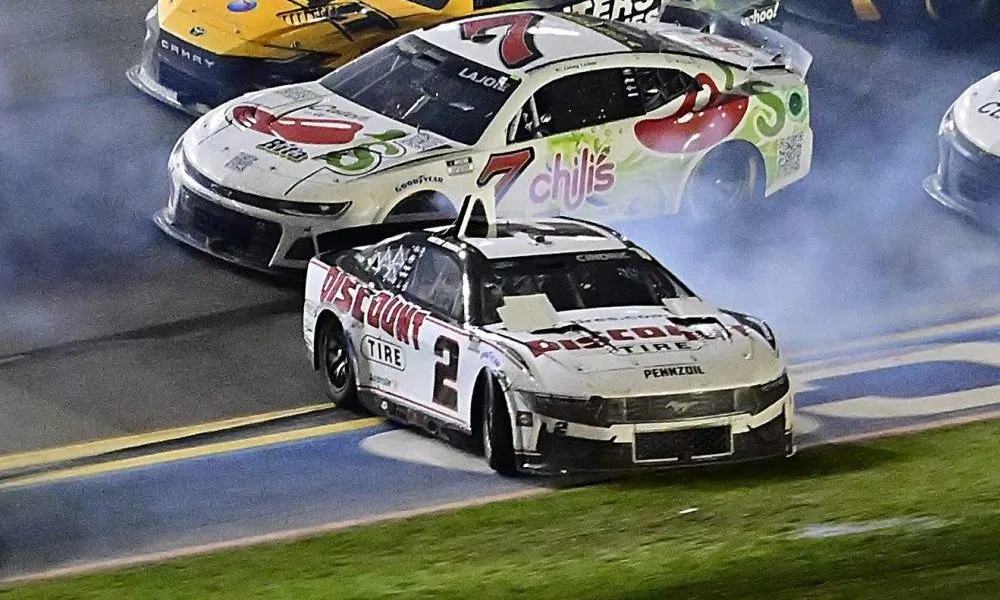
I knew that was a possibility because I’ve watched it happen a sickening amount of times, and for someone in NASCAR race direction to just assume that nothing bad would happen when, nine times out of 10 the bad thing happens, is infuriating to hear.
It is 2024. We should have a better solution with the technology and data available to us than to just hope that some random person hits the caution light when they should. Not when they feel like it, when they should.
Races should not end at the click of a button. I don’t think anyone that isn’t a Hendrick or William Byron fan was thrilled with the finish of this year’s Daytona 500. Alex Bowman being robbed of his chance to win the race by virtue of when someone clicks a button is not good enough.
Why can’t the rest of the field proceed as usual but the start-finish line is adjusted to try to get an authentic finish?
Sure, that might sound crazy, but road courses already do this for restarts and qualifying. It’s not an insane, out-of-left-field idea. It’s repurposing existing rules to reach a more satisfying conclusion to a race that fans sat for three hours (or more) to see.
Daytona is 2.5 miles in length. If we had a timing line for Monday night’s race placed close to the entry of turn 3 on the back stretch, we don’t have to worry about timing and scoring and the time of caution anymore.
We don’t have to watch tons of angles and footage to figure out the winner of the race. The drivers would be hitting a painted line on the track that was far enough away from the incident to serve as a finish line for the remaining drivers to reach.
My final, full proposal is as follows:
- One Overtime attempt
- If the caution is waved at any point, the race will be completed once the drivers hit the start-finish line to complete the current lap or an equivalent timing line designated by the race director in the drivers’ meeting prior to the event for tracks one-mile and larger unless otherwise stated
- A crash on the front stretch means the alternate finish line is before the third/final turn to give the field enough time to slow down and tread carefully through the site of the incident if necessary
- A crash in turns 1 & 2 means the alternate finish line is right after the exit of turn 4/final turn instead of the standard start-finish to allow for more deceleration
- A crash after turn 2 should always lead to a race to the start-finish line by remaining competitors unless otherwise stated below
- For tracks less than a mile in length, the field gets one Overtime attempt. If a caution occurs during this attempt, the field is frozen after the leader hits the next closest timing line, and the race is over.
- If a car is flipped or otherwise grossly compromised, the caution will be displayed and end the race at the next timing line.
- If a portion of the track itself is compromised (catchfence, flagstand, barriers, track surface, etc.) or is otherwise obstructed (stalled car, large debris, et al.), the caution should come out immediately with the race ending at the next timing line.
- If the caution occurs on the final lap of regulation, the above rules still apply.
My patience with the way NASCAR chooses to officiate races is withering away after every blown call, especially because there are easy ways to solve this issue.
The fans want to see the drivers fight to the finish (as safely as possible), so giving them as much opportunity to do that as possible would only benefit the sport’s image internally and externally.
But, NASCAR has a long, tired history of not knowing when to make a change, and after 20 years of this rule’s institution in various forms, it’s time to evolve.
(Top Photo Credit: HHP/Harold Hinson Photo)
 pitboxpress.com