For the entirety of the sports existence, NASCAR’s home has always been in the southeastern United States. Not only is our most iconic track, Daytona, located in Florida, most if not all cup series teams are based in North Carolina and over half the schedule taking place in that region.
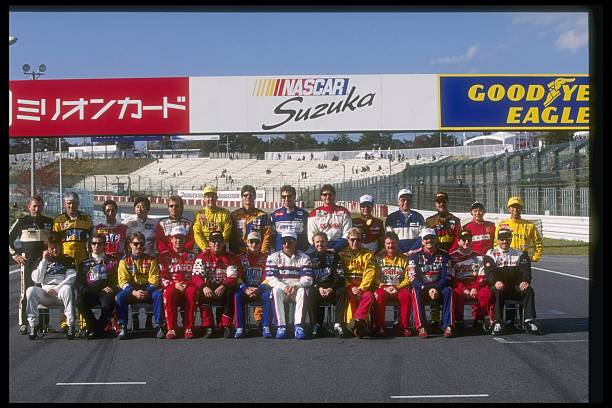
Despite this, NASCAR is no stranger to areas all over the USA, running races all the way in California. With nowhere else to go in the US, NASCAR looked international. As in 1996, NASCAR jumped across the Pacific and raced at the Suzuka Circuitland in Japan. So with the 2024 schedule right around the corner, and the buzz of an international race on everyone’s mind, I figured we would take a look at the surprisingly long history that NASCAR has in the Land of the Rising Sun.
NASCAR’s first expansion into Japan started all the way back in the early 1960s, as in 1963 the Japan NASCAR Corporation was formed and an exclusive contract for stock car racing was acquired. In June of 1964, the Corporation purchased a 1.5 million square meter (0.57 square mile) area of land at the foot of Mt. Fuji where a replica of the Daytona International Speedway would be built.
After the first set of banked corners had been built, 15 time F1 race winner Sir Stirling Moss was invited by the Japanese to view the construction. The Brit would tell the JNC that he felt it was unrealistic for a 2.5 mile superspeedway to be built on such mountainous terrain and that he had some reservations about the design.
It isn’t known the impact this statement had on the construction plans, but funds quickly dried up and the second set of banked corners could not be completed. The circuit was instead completed as a road course, incorporating a long straight and one set of banked corners. This change resulted in the NASCAR contract being abandoned, and the Japan NASCAR Corporation being renamed to the Fuji Speedway Corporation, and ownership of the track was handed over to the Mitsubishi Company. 4 F1 Grand Prix were held at the newly converted venue between 1976-77 and 2007-08.
The death of the Fuji speedway project was the last we heard of a NASCAR expansion in Japan for a few decades, as NASCAR focussed more on US operations.
From 1979 onwards, the popularity of NASCAR in the States grew and grew, quickly becoming a national sensation, finally gaining popularity outside of the southeast. And while NASCAR was going big in the US, other major American sports leagues were also capitalizing on the Japanese market, with both the NFL and the MLB hosting games in the nation. And in the early 90s, stock car racing would make its return to Japan.
Hiromishi Suzuki, general manager of the Suzuka Circuit at the time, visited the Daytona International Speedway to watch a NASCAR race. Amazed by what he saw, Suzuki set out to bring NASCAR to Japan.
Suzuki showed up to the NASCAR office unannounced, confusing the people there, but he was able to get an interview with Bill France Jr. Suzuki and France agreed they should cooperate and bring NASCAR thunder to the Suzuka Circuit.
Located just outside Suzuka City in the Mie Prefecture of Japan, the Suzuka Circuit is one of the most sacred temples of motor racing in the world. Having hosted the Japanese Grand Prix 10 times up to that point, and playing host to numerous iconic moments already, Suzuka was the obvious choice for NASCAR’s exhibition in Japan.
The first race would be held in 1996 on the East Circuit layout, which includes the iconic ‘S’ curves before rejoining the frontstretch just before the dunlop curve. The race itself would be 100 laps long, with a halfway break at the 50 lap marker. After the 50 lap break, the top 10 would be inverted for the start of the second segment.
Hiromishi Suzuki wanted to have some Japanese drivers in the field for the main event, and brought in 4 drivers, including hometown boy Hideo Fukuyama, as well as Keiichi Tsuchiya, Akihiko Nakaya and Kazuteru Wakida.
A total of 27 cars would be entered into the event, including newly crowned 2-time champion Terry Labonte and 7 time champion Dale Earnhardt.
Rusty Wallace would sit on the pole in the iconic #2, but he began to slip backwards before the halfway break in order to start up front in the second half. Jeff “Wonderboy” Gordon won the first segment and Terry Labonte cycled to the front with the invert. Wallace retook the lead shortly thereafter and held off both Gordon and Earnhardt in a one lap shootout for the win of the Suzuka Thunder Special. Suzuka City’s own Hideo Fukuyama in the #23 was running in the top 10 late, before being spun into the wall by Wally Dallenbach, sending the hometown boy back to 22nd.
The event was successful enough to warrant a second running the next year, this time 125 laps with 30 cars entering the main event, with drivers such as Mark Martin joining the fray.
Defending winner Rusty Wallace would only make it 8 laps before retiring with engine trouble, his main rival Dale Earnhardt joining him a few laps later due to overheating. It was Earnhardt’s teammate Mike Skinner who got the win that day, earning his first win in a NASCAR cup series car.
While the event was still a success, it was moved away from the Suzuka Circuit for the next year.
For 1998, the NASCAR exhibition in Japan would be held at the newly built 1.5 mile Twin Ring Motegi oval, located only 60 miles away from Tokyo.
The first race there, dubbed the Coca-Cola 500, would see 31 drivers compete, 27 from North America and 4 from Japan. Additionally, this race would be the first where Dale Earnhardt Jr. would compete alongside his father, Dale Sr., driving the #1 and #3 respectively.
Jeremy Mayfield sat on the pole for this race but quickly lost it to Jeff Gordon after the first lap. While many would claim the lead at one point or another, the drivers to beat were undoubtedly Jeff Gordon, who had already been unstoppable in 1998, and Mike Skinner, who had won Suzuka the previous year. In the end, Skinner romped home with his second win in Japan in just as many years. Gordon finished a tenth of a second behind him, and further back Dale Jr. finished 2 spots ahead of his father, with a solid 6th place.
After the Coca-Cola 500, NASCAR’s 3 year contract to race in Japan had come to an end. And for reasons likely to do with the high cost of shipping the cars across the pacific, and the low attendance of the races, NASCAR did not return to Japan. In 1999, the Winston West held their series finale at Motegi. The race, won by Kevin Richards, was the last time any NASCAR series raced in the Land of the Rising sun.
Should NASCAR return to Japan?
Well, it’s not outside the realm of possibility. With the recent success of the Clash at the Coliseum, NASCAR management has shown interest in potentially holding an international race at a stadium, with London and Tokyo being two cities name dropped as potential locations.
However, if NASCAR wanted to return to a legitimate racing track, the Fuji Speedway is the only practical option. The owner of the track, Toyota, is a manufacturer in all three series, so no doubt the company would be willing to host a NASCAR exhibition at their hometrack.
While the idea could be a hit with fans, it is not likely to resonate well with car owners. After all, NASCAR introduced the next gen car to lower the cost of racing for the teams involved, so taking a hop halfway around the world might not be too popular. And given the increasing talk amongst industry members about wanting more off-weekends, an additional race all the way across the pacific may be an issue.
Ultimately, NASCAR’s history in Japan is surprisingly deeper than it seems. From an abandoned Daytona clone at the base of the nation’s most iconic mountain, to multiple races at one of the greatest tracks in the world and the debut of a new racetrack that is still used to this day. NASCAR’s influence in Japan definitely had an impact on not only the racing culture in the country, but the sport itself as well. After all, the first time rain tires were ever used during a NASCAR weekend came at a practice session in Suzuka. Should NASCAR never return to Japan, then the time we spent there should be remembered fondly for what it was, an ambitious success.
Featured Image Credit: Yukio Yoshimi/Getty Images
 pitboxpress.com